PURCHASE
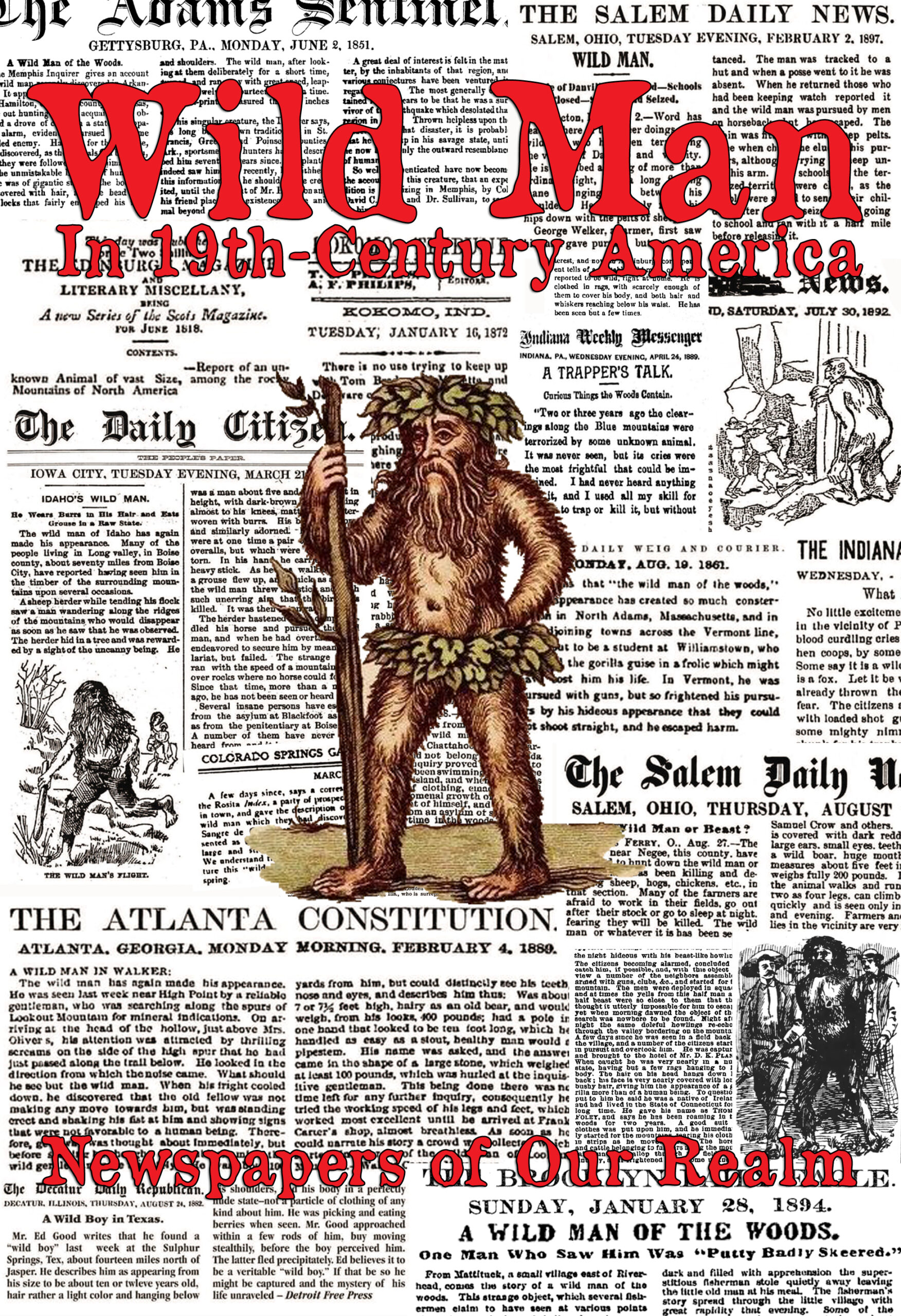
Wild Man In 19th-Century America
SURPRISED you, didn’t I? A brand-new title was slid onto the bookshelf and you never saw it coming. I kind of just snuck our latest release in there while your back was turned. Well, you can’t very well have a legitimate WILD MAN sighting and expect him to show. That’s not how it works. You have to be minding your own business on the mountainside when in the corner of your eye something stirs in the elderberry bush. Every picture will be blurry, or your camera will be shaky, and then nobody will believe you afterwards.
The latest and long overdue second entry of our Newspapers of Our Realm series involves nearly every 19th-century newspaper article that I have tracked down pertaining to the wild man. Already, some of you are wanting to correct me and call him Sasquatch or Bigfoot. The problem is, if I did that, then I would be promoting a modern exhibit from the 20th or 21st-century crypto zoo without letting the pioneering witnesses and the newspaper men speak for themselves. Why silence them? Though it is true, the sasquatch that we have all come to know arrives in these eyewitness accounts, and in fact very early on, I was initially perplexed to discover two competing traditions, only one of which has won the day. A very different wild man prototype, perhaps the most commonly observed wild man of all, seems to have evaded all pursuits with such purposeful intent that he has altogether vanished from modern western consciousness. He is described as a literal man in appearance, albeit hairy with a beard and swift as a deer, who sometimes dresses in animal skins, pants, and shoes (though he has a penchant for the nude as well) when haunting secluded villages, howling devilishly from just beyond the tree line of the untamed frontier. Usually he cannot talk intelligibly but on occasion he will answer questions or form banal sentences. Time and again he is also described as being in his forties. Why didn’t he age a day past 49 and what is his youthful secret? If only we could ask him.
For my reader, it is likely that the existence of sasquatch is a certainty, but then what of the crazed prospector prototype? Who is more confused in their description of him, the people who had the displeasure of encountering him centuries ago or we today, given our supposed sophistication and evolution of research? In Wastelands of the Seraphiym, I noted the inconvenient fact that, given the century, spiritual entities change in physical appearance according to eyewitness accounts. My proposal is that the supernatural realm needs pop culture in order for the creative and logical sides of our brain to harmonize and perceive them in the third dimension. Art changes. Culture changes. The wild man of the 19th-century often takes on the furry mantle of the medieval woodwose while combing contemporary elements of American folklore. I am reminded of Johnny Appleseed, had he contacted cabin fever, or perhaps more appropriately an encounter with the devil in a Washington Irving novel. Fast forward to today and the sasquatch is aligned with aliens. Where are the accompanying UFO sightings in the 19th-century? There are none. Even his narrative has evolved. If sasquatch is a spiritual entity and a caretaker of the forest, as I generally believe him to be, then are we peering in upon him from a different frame of reference, time, and cultural context, or were the fairies of old far more diverse than we often give them credit?
But then, in a game of telegraph tag, is it really a case of eye-witnesses and the press who are hampered by the constraints of pop culture and religious oversight, or is something more sinister at play? How much of the wild man tradition, and in fact pop culture as a whole, was an invention of sensationalist writers and the propagandists of yellow journalism, complete with a phantom voter base to back them as eyewitness? Media manipulation becomes lazy and glutenous when they know the average consumer cannot or will not venture out to investigate these claims for themselves. You’ve likely heard about the mud flood and Tartaria. From a conspiratorial perspective, and a plotline reminiscent of M. Night Shyamalan’s The Village, was the archetypal wild man fabricated in order to keep frontiersmen on the trail, far away from “old world habitation” which had yet to be discovered? It’s a thought. While attempting to rationalize his existence, newspapers constantly evoke an escaped lunatic from an asylum, an AWOL soldier from a past war, an orphan, a dissenter from society, or a survivor from a traumatic natural event. Why the sudden need for so many asylums and the medicine they were spoon feeding them? Had that many people really gone missing in a natural cataclysm? Sometimes the wild man is mistaken for a literal hermit, a “negro” or “Mexican” on the loose, and for investigative purposes, I felt the need to include those. Were wild man atheists pushing mistaken identity stories as misdirection? These same writers will also gaslight you by calling you a lover of the bottle or “superstitious” for believing in his actual existence—unless, that is, you conclude along with the other third graders that the circus has the terrible habit of letting its gorillas escape. Well, there is another credible wild man category for you. In some instances he is reported to be an actual ape. Why must the wild man simply be one scenario or the other?
The sheer number of stories being reported upon truly are stunning. I found myself savoring the shorter articles, where a newspaper might grudgingly report upon the wild man’s ongoing pestilence among a secluded community, and in no more than a couple of passing sentences, rather than serenade his readership with the fantastical exploits of a lone hero reminiscent of a western novel. Frankly, I was surprised by how many wild man tracks I uncovered in the annals. I was expecting a dozen or so sasquatch stories, not a book of material spanning every corner of North America—north, south, east, and west. When all the various puzzle pieces are assembled, the wild man looks as though he was a legitimate reality for many Americans living in solitary places, where the virgin forests had yet to be cut down. You will also find your own belief challenged when he is reported as being captured or killed on far too many occasions for casual comfort, given the lack of evidence. The easy and seemingly obvious conclusion is to arouse the skeptic and shrug them off as dime museum hoaxes. But then, what if the wild man shares a similar fate to the bones of giants in relation to the Smithsonian. That was the theme of the first book in this series, Giants In America. Knowing that His-Story as we know it has been scrubbed, and that the history writers often change their story, do these newspaper articles serve as residue?
Supposing these newspaper writers do reflect the common understanding of their time (though much like the media’s mishandling of the common experience today, I highly doubt that to be the case), then a recognition of the thinly veiled spiritual realm was frowned upon in a post-Newtonian and Copernican world. That may very well have been true among the normies. They may have settled into a material matrix with ease. The media has always had them under their spell. Therefore, I suggest to you that the wild man is a legitimate narrative pitted between real people, perhaps even a silenced people, in conflict with the gradual evolution of histories storytellers.
Imperative to this research is taking all newspaper accounts into consideration, as I have already explained. The good, the bad, and the ugly. Give it a try, you might be surprised what you’ll find. I will quickly tell you my favorite story. On July 28, 1884, it is reported by the Oshkosh Daily Northwestern that hunters spotted a wild woman standing like a statue in an open field, back turned to them. The way their encounter is described, I could imagine the entire unfolding scene, as though I too were standing there—watching her. I figure she was alerted to their presence before they were of hers but was caught in a clearing and hoped to remain unseen. At nearly 200 pages, every article was lovingly copied by my hand.
Noel