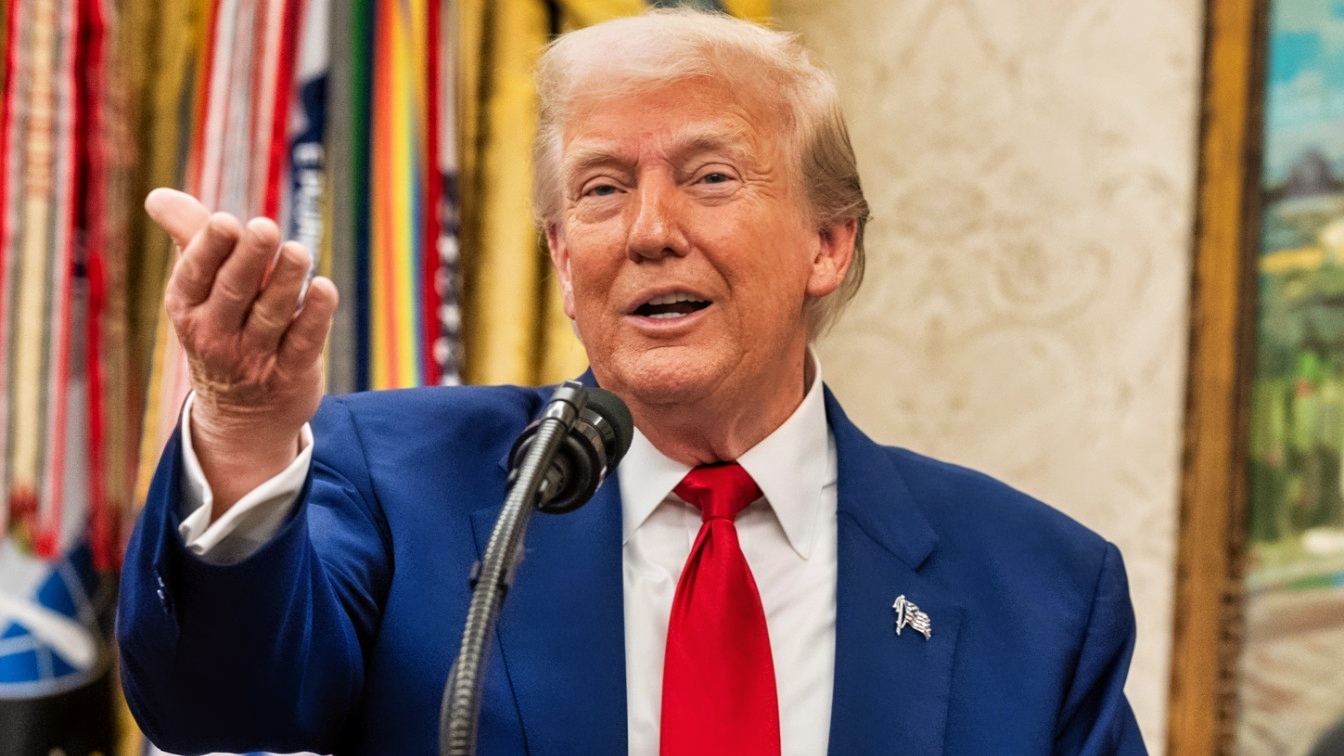
The Hormuz Crisis Could Reshape Global Oil Markets Forever: U.S. President Donald Trump said this week that “ships are starting to move” through the Strait of Hormuz after announcing the signing of a memorandum of understanding (MOU) with the regime in Tehran.
The MOU lays the foundation for a potentially lasting peace deal between the United States and Iran in the next 60 days – and should all go to plan, the Strait of Hormuz should remain open to commercial oil traffic for the foreseeable future.
F-15I Fighter Israeli Air Force. Image Credit: Creative Commons.
Ignoring the fact that a lot could go wrong between now and then, and that there’s no reason Hormuz won’t once again be disrupted by various geopolitical problems or exchanges of fire between Hezbollah and Israel, there will be one major and unavoidable economic consequence of the new deal: the Gulf oil market may never look the same again.
For decades, governments, oil traders, shipping companies, and refiners have operated under the assumption that even serious tension in the Persian Gulf would be only temporary, or indeed that such tensions are unlikely to cause a shutdown of traffic due to the major economic consequences that would result.
The events of the past several months prove that to be wrong.
The threat of a prolonged closure of the world’s most important energy chokepoint has now pushed policymakers and industry officials to reconsider these assumptions and prepare accordingly. Not only are alternative pipelines coming online, but a series of other major changes to the global oil market are likely to arrive in the near future.
The Gulf Is Far Less Safe
Before the latest conflict, the market generally viewed disruptions in the Persian Gulf as temporary. Even the 2019 attacks on Saudi Aramco facilities at Abqaiq and Khurais, which temporarily knocked out almost 6 million barrels of Saudi oil production, were short-lived.
Nobody involved in the oil trade believed the situation was ideal, but the economic consequences of a prolonged shutdown would be so severe that normal operations, for the sake of the global economy, would resume quickly.
The events of this year have no doubt challenged that thinking, with only a fraction of the 20 million barrels of oil and petroleum products that normally made it through the Strait of Hormuz escaping the region.
One-fifth of global oil consumption was affected, with shipping companies finding their vessels stranded in the Gulf, insurers forced to raise rates to unsustainable levels, and Gulf states moving as much oil as possible through alternative routes such as the East-West Crude Oil Pipeline.
Future tensions involving Iran, we now know, are likely to trigger stronger reactions in energy markets than before. Even if traffic through Hormuz resumes fully in the coming weeks or months, traders now know that the geopolitical risk in the Gulf is severe, and that there is no guarantee the full force of the U.S. military can stop the regime in Tehran from holding the world economy hostage.
Oil Importers Will Look Beyond the Gulf
According to the Energy Information Administration (EIA), approximately 82 percent of all crude oil and condensate moving through the Strait of Hormuz in 2024 was destined for Asian markets. That makes Asia by far the biggest dependent on Gulf exports, with China alone accounting for roughly 5.4 million barrels per day in 2025, and India 2.1 million barrels per day. Given that huge dependence,
Middle Eastern oil is unlikely to disappear from Asia’s energy mix, but the latest disruption will almost certainly accelerate efforts to diversify supply chains – and may even force some economies to look for ways to utilize alternative fossil fuel energy sources.
Some economies are already preparing, too. Customs data show that Beijing has steadily increased its purchases from Brazil over the past several years while maintaining trade relations with West African suppliers.
In the long term, the United States might also begin to benefit from the shift, with American crude exports reaching record highs in recent years and regularly exceeding 4 million barrels per day. In May 2026, U.S. exports climbed to over 10 million barrels per day. For the time being, though, Asian importers will remain constrained by their refining infrastructure, which is designed to process heavier Middle Eastern oil grades.
Strategic Reserves Matter – and the U.S. Is Behind
A third lesson from the Hormuz crisis, and one that may really change things for major economies that can afford to adapt, is that governments cannot assume that global markets can absorb every supply shock.
Had the Hormuz disruption continued through July, many analysts predicted that the world would have faced a full supply crisis, and not just a temporary price hike. Strategic petroleum reserves are now more important than ever. China knows this, and that’s why its reserves exceed one billion barrels of oil. The United States, however, has a big job ahead of it.
Data released by the Department of Energy this week showed that the U.S. Strategic Petroleum Reserve had fallen to 340.3 million barrels – its lowest level since 1983 – following a series of emergency releases designed to offset disruptions caused by the Iran conflict.
The U.S. reserve did its job in this case, but replenishing those stockpiles will take years, particularly if oil prices remain elevated. However, if the geopolitical turmoil ultimately shifts market share in favor of American producers, record U.S. output and exports could help ease that burden and offset the costs.
Either way, the message is clear: after Hormuz, energy security should become a priority for every major economy that can afford to act.
About the Author: Jack Buckby
Jack Buckby is a British researcher and analyst specializing in defense and national security, based in New York. His work focuses on military capability, procurement, and strategic competition, producing and editing analysis for policy and defense audiences. He brings extensive editorial experience, with a career output spanning over 1,000 articles at 19FortyFive and National Security Journal, and has previously authored books and papers on extremism and deradicalization.