
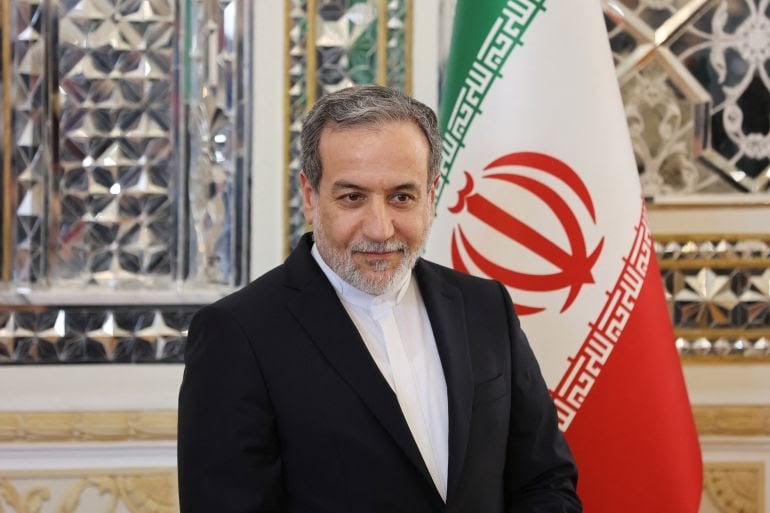
“If the United States thinks that building up massive force around us will make us surrender, that will not happen,” Araghchi said.
By World Israel News Staff
As negotiators prepare for what many officials describe as a last-chance round of diplomacy, Iran’s Foreign Minister Abbas Araghchi said Tehran is prepared for both conflict and agreement, underscoring the high stakes surrounding talks set for Thursday in Geneva amid an expanding U.S. military buildup across the region.
Speaking in an interview with India Today, Araghchi said Iran is entering negotiations with cautious optimism but warned that its armed forces remain ready should diplomacy fail.
“Of course we are ready,” he said. “We are completely prepared for both possibilities, war and peace.”
Araghchi confirmed he is traveling to Geneva for a third round of negotiations with the American delegation, saying previous discussions had produced limited progress and a preliminary understanding that could serve as the basis for a broader agreement.
“In the previous round there were advances. We reached a certain level of understanding, and on that foundation we can build something within an agreement,” he said, adding that a “fair, balanced and just deal” remains achievable if both sides demonstrate genuine commitment.
The Iranian foreign minister framed military readiness as a means of deterrence rather than escalation, arguing that preparation for conflict is intended to prevent one.
“When you are prepared for war, you can prevent it. Otherwise, you invite it into your home,” Araghchi said. “We are fully ready, not because we want war, but because we want to prevent war.”
At the same time, he dismissed the effectiveness of mounting military pressure on Tehran, saying Iran would not be coerced by expanding American deployments in the region.
“If the United States thinks that building up massive force around us will make us surrender, that will not happen,” Araghchi said.
His comments come as U.S. forces continue a significant military buildup across the Middle East, including expanded naval deployments, additional air assets, and the recent deployment of advanced fighter aircraft to the region. The parallel tracks of diplomacy and military preparation have heightened perceptions that the upcoming talks could represent a decisive moment in the crisis.
Addressing Iran’s nuclear program, Araghchi rejected the idea of a military solution, insisting that concerns over Tehran’s activities should be resolved through negotiations and international oversight rather than force.
“There is no military option,” he said. “If there are concerns or ambiguities, we are ready to address them, answer questions, and remove doubts. But we are not prepared to give up our right to peaceful nuclear technology.”
Araghchi reiterated Iran’s longstanding position that it does not seek nuclear weapons, while maintaining that civilian nuclear development remains a sovereign right. He also claimed Iran has voluntarily limited the range of its missile program to under 2,000 kilometers, describing its capabilities as defensive and intended solely for deterrence.
At the same time, the Iranian diplomat expressed deep skepticism toward Washington’s intentions, citing past negotiations that coincided with military confrontation.
“We are not fully convinced there is real determination on the other side to reach an agreement,” he said. “We have bitter experience from the previous round. While we were negotiating, we were attacked. That memory is still fresh for us.”
Despite those concerns, Araghchi said a diplomatic breakthrough remains possible if negotiations proceed in good faith.
“If there is serious and genuine intent from the other side, I believe an agreement is achievable,” he said.
With negotiators heading to Geneva under mounting international pressure, evacuations and travel warnings issued by foreign governments, and military forces repositioning across the region, officials increasingly view Thursday’s talks as a pivotal test of whether diplomacy can still avert a broader confrontation.
The post Iran foreign minister warns pressure won’t force surrender appeared first on World Israel News.