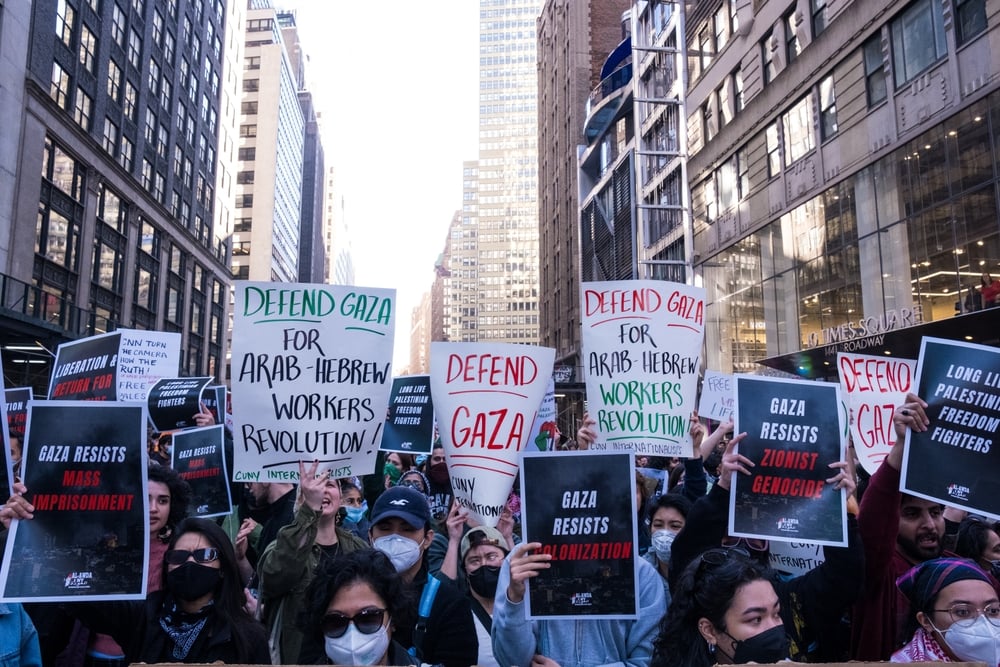
Many respondents indicated they were unsure whether charged slogans such as “globalize the intifada” were antisemitic, and nearly half of the national sample said that calling the situation in Gaza a “genocide” was not antisemitic.
By Corey Walker, The Algemeiner
The Israeli–Palestinian issue barely registers as a meaningful priority when young American voters decide how to cast their ballots, despite anti-Israel and antisemitic sentiment rising sharply among this voting bloc, according to a new national survey.
The findings of the Yale Youth Poll, an undergraduate-led research project at Yale University, highlight a widening generational divide.
According to the poll, which surveyed a roughly equal number of voters aged 18-34 and their older fellow Americans, younger respondents indicated they were far more likely to embrace narratives portraying Zionism as racist, to reject Israel’s existence as a Jewish state, and to support reducing or ending US military assistance to Israel.
A sizable share of voters 18–22 endorsed statements long used to measure antisemitic bias, including questioning Jewish-American loyalty to their home country (30 percent), supporting boycotts of Jewish-owned businesses as a form of political protest (21 percent), and agreeing that Jews have “too much power” in the US (27 percent).
Among the youngest group, only a slim majority rejected all antisemitic statements measured.
The survey also shows a deep lack of clarity among young Americans about what constitutes antisemitism.
Many respondents indicated they were unsure whether charged slogans such as “globalize the intifada” were antisemitic, and nearly half of the national sample said that calling the situation in Gaza a “genocide” was not antisemitic.
Younger voters were considerably more likely to choose definitions of Zionism that frame Israel as an oppressive or colonial project, rather than as the right of the Jewish people to self-determination in their ancient homeland.
A striking 27 percent of those aged 18-22 said they believe Israel has a right to exist “but not as a Jewish state.” Just 24 percent of this age bracket believe that Israel should remain a Jewish state, according to the data.
A plurality, 34 percent, said they are “not sure” what Israel’s political and cultural identity should reflect.
A large portion of young voters seem to be unaware of the definition of Zionism. Many of these Americans, according to the poll, perceive Zionism as an effort to dispossess Palestinians of their land and human rights.
Among respondents aged 18-22 and 23-29, 27 percent and 25 percent, respectively, indicated they are “not familiar” with the term Zionism.
Another 27 percent and 30 percent of voters aged 18-22 and 23-29, respectively, believe that Zionism is “a movement for self-determination
and statehood for the Jewish people.”
A striking 36 percent of respondents aged 18-22 described Zionism as “establishing and maintaining a Jewish demographic majority in Palestine by driving out the native Palestinian population.” Similarly, 35 percent of those aged 23-29 responded with the same belief.
Yet at the same time, the poll reveals that Israel simply does not factor prominently into the political priorities of these same voters.
When asked which issues would influence their vote, young Americans overwhelmingly named domestic concerns: cost of living, housing, democracy, jobs, and free speech.
Foreign policy, including the Israeli-Palestinian conflict, fell near the bottom of the list, far behind economic pressures shaping daily life. Only 25 percent of voters indicated the issue was important, ranking below Russia and Ukraine (33 percent).
This disconnect appears to show anti-Israel attitudes and antisemitic beliefs are normalizing among the youngest slice of the electorate, but without clear political salience.
The danger, according to some experts, is that these views may spread unchallenged because they sit unexamined in a political landscape consumed by economic anxiety.
The poll, conducted from Oct. 29 to Nov. 11, sampled 3,426 registered voters, including 1,706 voters aged 18-34.
The post Israeli-Palestinian conflict a low priority for young Americans, despite rising anti-Israel views, poll shows appeared first on World Israel News.