THE SCENE was Sotheby’s Auction House in London. It was just after luncheon on July 13, 1936. The clock struck one. Bidding began. If appetites were not yet assuaged by the food and drink presently settling in their bellies, it is simply because the item before them was a truly remarkable find. From the bidding room floor attendees beheld a metal chest containing Sir Isaac Newton’s private hand-written papers and lab books. Newton’s own Alma Mater, Cambridge University, had acquired the treasure chest from the Earl of Portsmouth in 1872. Soon thereafter, a dedicated team of scholars set out to catalogue its contents. “This was Newton, after all,” writes Sam Kean in Humanities, “and they were hungry for any insight into how he’d developed his theories of motion, gravity, light, and color.” They were, Kean enforces, “work that defines the very Newtonian universe we inhabit.” And yet, upon completing their studies sixteen years later, those papers were never published—strange indeed. Cambridge simply returned the bundle they had acquired, practically all of it, to its original owner, on the basis that they had “no scientific value.” In turn, the hidden compartments of Newton’s mind were soon forgotten, as intended, and barely survived a house fire some three years later. But Newton’s secret knowledge would not remain hidden for long.
At Sotheby’s in London, Newton’s metal chest fell into the hands of the highest bidder—an amateur collector. Economist John Maynard Keynes sought papers on any topic of his, but after July 13, 1936, all of that would change. The father of modern science, Keynes would soon learn, was an alchemist. Cambridge had simply decided that alchemy was a disfigurement to the very paradigm which Newton had helped us to own. Keynes then set about acquiring anything of Newton’s that might give insight into Newton the hobbyist. But as his alchemical papers continually filled his mailbox, Keynes finally acknowledged the inevitable. Alchemy wasn’t simply a secret avocation. Alchemy was Newton’s life work. In 1942, some six years after his initial discovery, Keynes concluded before distinguished members of the Royal Society, Newton “was not the first of the age of reason. He was the last of the magicians.”
“Newton was not the first of the age of reason. He was the last of the magicians, the last of the Babylonians and Sumerians, the last great mind which looked out on the visible and intellectual world with the same eyes as those who began to build our intellectual inheritance rather less than 10,000 years ago. Isaac Newton, a posthumous child born with no father on Christmas Day, 1642, was the last wonder-child to whom the Magic could do sincere and appropriate homage.”
His choice words are important here. Keynes does not shy from anointing Newton with messianic oil, comparatively with Jesus Christ, and most ironically born not on the night of Christ’s historical birth, but a date deeply embedded with Occultism. It is Newton, Keynes stresses, who stands as a legitimate priest of the Babylonian whore religion. It is through Newton in which we are delivered our inheritance apart from divine revelation, and purposed for the sort of soul, Jesus once identified, as a son demanding his father’s inheritance so that he might live among the pigs in a foreign land; the sort of soul, John further affirms, who claims his or her inheritance with Satan and his angels in the Lake of Fire.
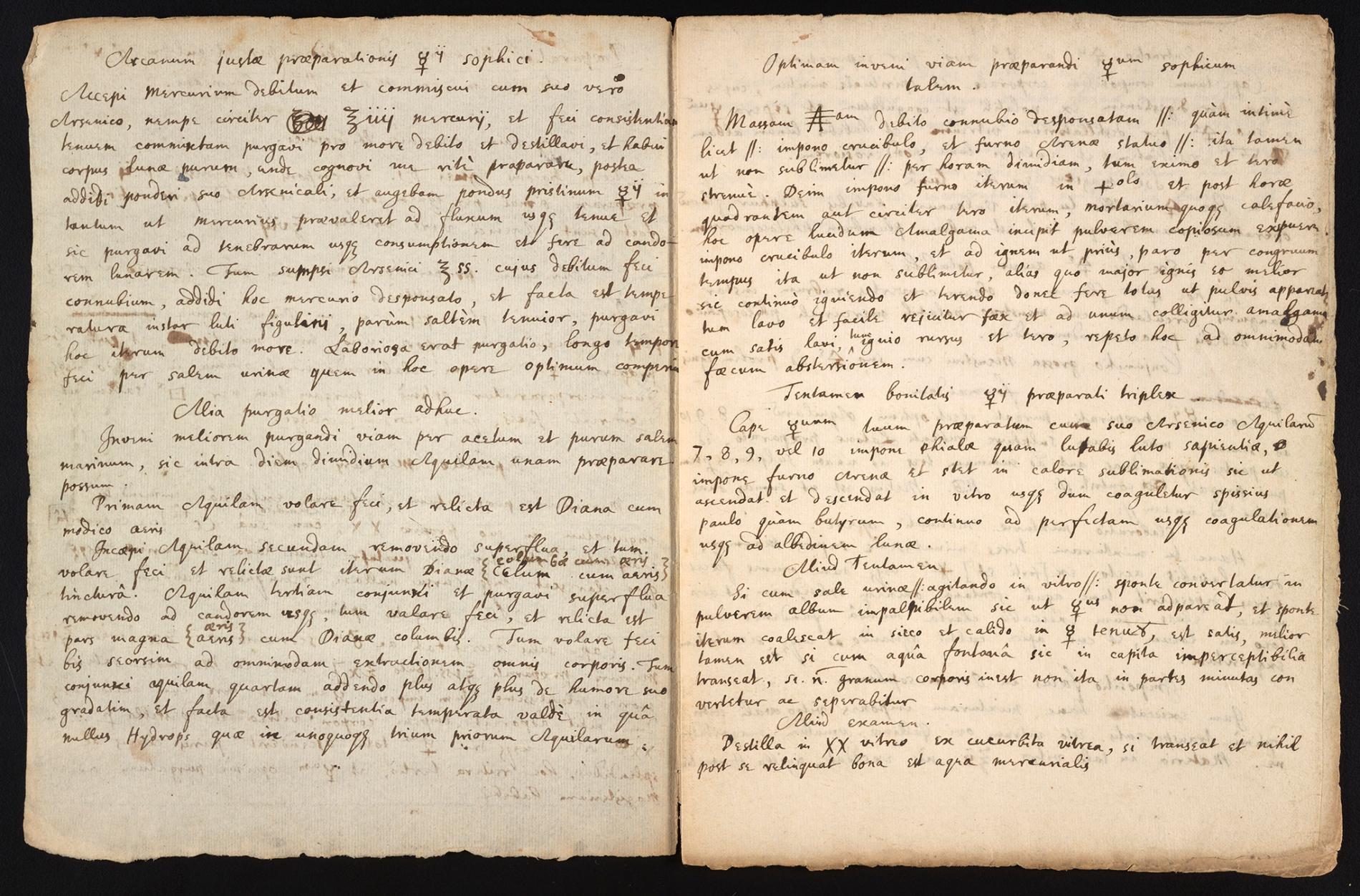
The roots of alchemy derive from metallurgy. Essentially, by applying intense heat to specific rocks they can be purified and transformed into metal. In The Rise and Fall of Alexandria: Birthplace of the Modern Mind, authors Justin Pollard and Howard Reid write: “From the very start this process acquired occult or secret status, and the objects produced by this sacred craft—ornaments, jewelry, and currency from gold and silver; weapons and tools from copper, its alloys, and iron—were always given high prestige and value.” We are once more directed to Song of the Sword in Genesis 4:23-24, proudly recited by Lamech (the lineage of Cain), and choreographed no doubt by the murderous weapon he presently brandished, and then the Watchers of Enoch who had helped him to it. Pollard and Reid continue: “It’s clear from ancient texts that iron especially had divine qualities: The Egyptians called it the ‘metal from heaven’; the Babylonians, ‘celestial fire.’ These and other sources make it seem likely that people first encountered iron as meteorites which had fallen from heaven to earth. When they later discovered the same metal underground, inside the womb of Mother Earth, it must have seemed like confirmation of the metal’s divine status.”
For hundreds of years alchemists toiled to produce a mythical substance known as the philosopher’s stone. The supposedly dense, waxy red material was a thing of legend—an alchemical substance capable of turning base metals such as lead or mercury into gold. “There are close parallels between Egyptian beliefs and practices concerning death and the afterlife and the theory and practice of alchemy that developed in the medieval world,” writes Pollard and Reid. “More specifically, the Egyptian Book of the Dead offers precise prescriptions for the transfer of the human soul from life to death and then to rebirth in immortal form which are extremely close to the prescriptions adopted by alchemists.”
Cleary, Newton was in the know. The philosopher’s stone was also called the elixir of life. It’s goal, rejuvenation of the soul. It is the promise of immortality which attracted Newton. And Alexandria, as it often did, had the hieroglyphs, apparently, to back it. “He knew perfectly well that all this talk of transforming metals was just a façade, even a cover, for a far more profound spiritual awakening,” Pollard and Reid again. In Keynes collection of papers, Newton himself wrote: “For alchemy does not trade with metals as ignorant vulgars think, which error has made them distress that noble science, but she has also material veins of whose nature God created handmaidens to conceive and bring forth its creatures.”
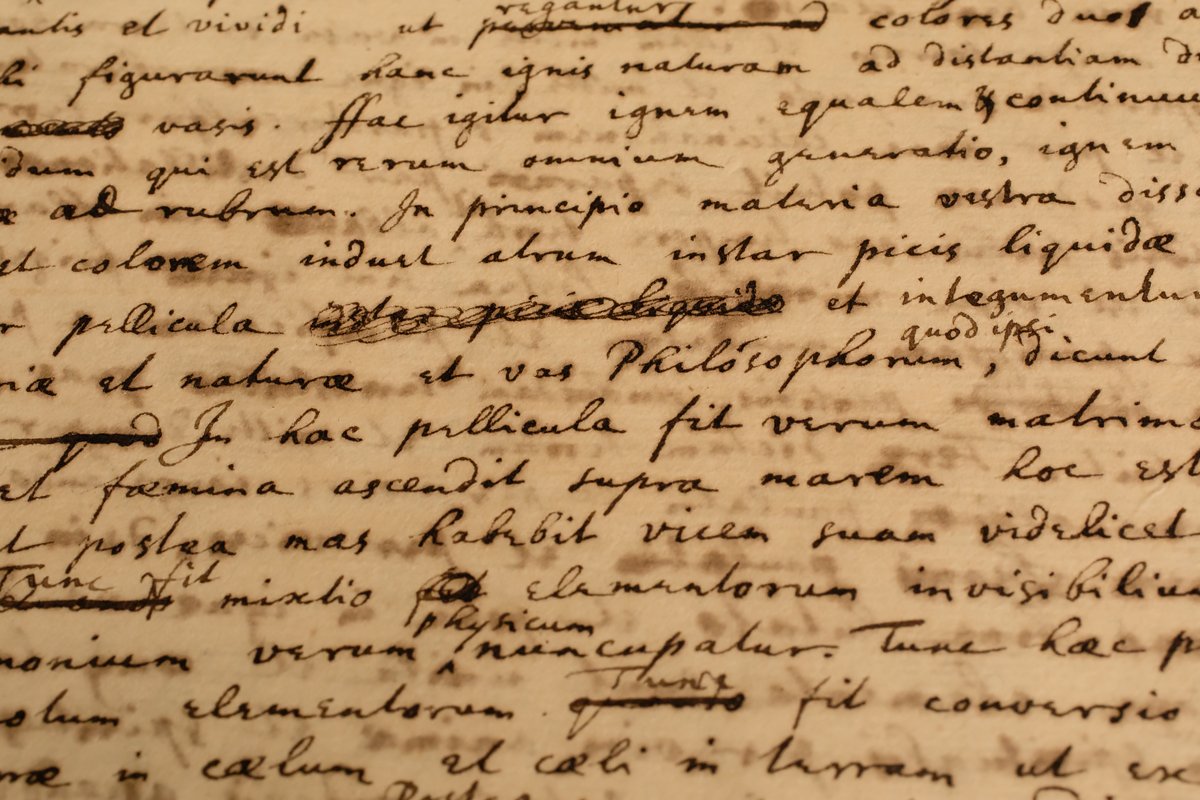
It would be difficult indeed to track down a phone book of researchers which contained even one scholar who had read the entirety of Isaac Newton’s work. No such directory exists. With an estimated 10 million written words having survived the centuries, half of which is of the religious nature and another one million devoted to alchemical material, his is a behemoth collection. Even Sarah Dry, author of “The Newton Papers: The Strange and True Odyssey of Isaac Newton’s Manuscripts,” laughs at the very notion. Though, concerning its contents, she warns, “And one of the messages of the book is that getting too involved in the papers can be hazardous to your health. One of the first editors of (Newton’s) papers said an older man should take up the task, because he’d have less to lose than a younger man.”
But this we know. Isaac Newton was a disciple of “Jewish philosophy, the mysticism of Kabbalah and the Talmud;” This, according to Aron Heller at the Times of Israel. What most Christians fail to recognize or know—or rather, the cat which has remained for the most part in the bag—is that Isaac Newton was a mystic and occultist. When nobody else was looking, he exhumed rotting flesh from Alexandria, and that corpse was Hermes Trismegistus.
Pollard and Reid further write: “Few realize that his occult work, his alchemical studies, gave him the keys to the biggest breakthrough in his life. Alchemy insists that there are unseen, invisible forces at work in the universe, capable of acting on objects at a distance. An apple may (or may not) have dropped on Newton’s head, but beyond a shadow of a doubt, it was alchemy which prompted Newton to formulate the notion of gravity—alchemy which had been rendered into a coherent and communicable, if secret, code in Alexandria.”
Pancoast, author of Kabbala: Or True Science of Light (1883) celebrates Newton’s discovery of gravity when he writes: “Indeed, so much of the Newtonian Philosophy do we find in the ancient, that we cannot doubt he had been exploring the old mines of Kabbalistic lore, and had arrived at his great discoveries by following up clues gained therefrom.” Again he writes: “He (Pythagoras) was never permitted to declare publicly what he knew and believed, but taught his immediate pupils all the wonders of his philosophy, under the most binding obligation of secrecy. Pythagoras was forbidden to divulge this knowledge because it would reveal the law of attraction and repulsion, which constituted one of the great secrets of the sanctuary. Over a millennium later, Newton was led to the discovery of these forces by his studies of the Kabbalah.”
It is of no coincide then that Abraham Yahuda, a Zionist Jew and contemporary of Albert Einstein, scoured the world collecting Newton’s religious writings. According to Sarah Dry, Yahuda “set about trying to purchase the Newton papers and wrote to (his wife) Ethel on July 28, ‘I am thrilled with the thought of acquiring them. He wrote a lot about the Bible and the Jews, about Cabbala and all sorts of Jewish questions.”
Einstein took an immediate interest in his work. According to Dry, Einstein had hoped that Newton’s papers would never get published. “Einstein considered Newton’s private papers with an eye toward gleaning as much as possible of his method of discovery, what he refers to here in ‘the formative development’ of his work in physics. Einstein implicitly links the process by which Newton developed his physics and his theology; by studying the one, we might gain insight into the other.”
Gravity simply cannot be proven. No apple can do that. What’s worse, it cannot even be tested except by the measure of a man’s faith. Neil DeGrasse Tyson might phrase it like this, “the Universe doesn’t have to make sense to you.” Just believe. Despite what Carl Sagan and his contemporaries might demand of adherers to the scientific method, the entire heliocentric religion is often explained with the familiar flag colors of pseudo-science. Make no mistake about it; the theory of gravity is Kabbalah through-and-through. According to Migene Gonzalex-Wippler, author of The Kabbalah & Magic of Angels, gravity “is equated with Tiphareth, the sixth sphere of the Tree of Life.”
Author Edward Hendrie sums it up like this: “Gravity is not only an attribute of the Jewish god, Ein Sof, it is actually one of the god’s of the Kabbalah, in its own right.”
I guess I just want to know why our so-called understanding of modern astronomy and the most basic ideas in string theory today, as well as astrophysics, not forgetting Newton’s gravity, all seem to concur with Babylonian mysticism in so-much as they’re mirrored astonishingly with the Zohar and Kabbalistic texts of old. They’re certainly advertised as such. Specifically, in my pursuit of understanding Jewish mysticism and its necessary visage behind today’s establishment of Copernican and Darwinian Scientism, a deception which the Lord has gladly delivered me out of, I want to know why modern Christians, who are so hasty in dismissing God’s revelation of creation in the Bible, mocking the very notion that its intended as literal, are so eager to back up the Zohar’s literal account of it
If, according to the big bang theory; matter, space, and time all instantaneously collaborated in their formation, or “10” is the number for space-time in string theory, with “26” standing out as a requirement for mathematics in bosonic string theory, with both numbers agreeably forming the building blocks of the universe through “magic dimensions,” as modern theorists claim, in Kabbalah and modern science, how it is that medieval Jewish writers so splendidly divided truth from fantasy without knowing today’s mathematics or physics then, well, I guess I’m stumped—if modern scientists are truly “rediscovering” it, that is. And that’s the thing. How one perceives this, be it a fantastical retelling in the department of wishful thinking or coincidental and completely innocent discovery in the pursuit of truth—well, one’s personal conclusion changes everything.
I’m especially intrigued by Kabbalah’s teaching regarding “God’s retreat,” or emptying Himself from the cosmos by retracting infinite light, so as to make room for big-bang creation, and how the new spirituality of Scientism can match this to portray everything before us as a potential vessel for the enlightenment of divinity. After a while, Darwinian Evolution and the Babylonian religion and the Copernican globe, each apparently backed with these Kabbalah texts, all bleed into the same agenda—the Luciferian lie.
Isaac Newton, high priest and wizard.
I realize now that talking about Kabbalah and Babylonian mysticism wasn’t my actual intent when sitting down to write this, nor was it the secret papers of Newton. So far as my reevaluation into astronomy and astrophysics has gone, now that I’ve decided to take my stand with a Holy Word which outright opposes such beliefs, all of this, particularly my previous indoctrination into the very system by which I claimed to oppose, has produced more of a culture shock, if anything. If I never realized the extent to which Creationists fooled me into believing their pursuit of Science was a Biblical one, it’s simply because never in all my life could I nor did I wish to believe that my own church leaders would pull the wool over my eyes in either stance, be it a purposefully deceitful or subconscious decision on their part. I certainly didn’t set out on this quest considering either two as an option, not even in the back of my inner-skull, and yet here we are.
Now we peel the curtain of the great hypocrisy. I was instructed to align myself with creationists who willingly apply cosmic evolution into their teachings of Biblical astronomy, among other disciplines. I’d hear them talking about stars and planets being formed by the coalescing of cosmic gases or starlight traveling from quadrillions of miles away and somehow incorporating that belief-system into Genesis while simultaneously adding a young-earth time stamp for our approval, and convince myself that the very “Science” by which they were rationalizing was somehow a Biblical one. Quite frankly, it’s not.
This all goes back to my original question. I guess I just want to know why modern Christians, who are so hasty in dismissing God’s revelation of creation in the Bible, mocking the very notion that it’s intended as literal, are so eager to back up the Zohar’s literal account of it. Are we so arrogant as to claim we know more or better than God’s own testimony of Himself through creation, described by Moses, the prophets, scribes, poets, and Apostles, as to oppose it, or is it at all possible that, by skewing off the straight and narrow path in our solitary pursuit of quantifying what was once-hidden in creation, disclosures perhaps never intended to be found at all, it isn’t a better understanding of “God” that we’re actually discovering?
In a 1991 issue of Christianity Today, “Women in the Medieval Church,” Charles E. Hummel dedicated the sort of lovey-dovey propaganda-piece to Isaac Newton, dripping with all the springtime sap and the patriotic fluff and gloop of a tender-hearted eulogy, which a proponent of gravity or Scientism delusionist, as well as Newton’s own descendants could be proud of. Hummel writes, “A member of the Anglican church, Newton attended services and participated in special projects, such as praying for the distribution of Bibles among the poor.” In the same article, he douses an extra coating of sugar-coated frosting with: “Newton’s understanding of God came primarily from the Bible, which he studied for days and weeks at a time.”
Strange indeed that Christianity Today thought it unimportant to divulge the fruit of Newton’s laborious studies—mainly, what his “understanding of God” entailed. Despite the fact that, during his own lifetime, Newton was a master of the mint, mathematics professor at Cambridge University, President of the Royal Society, and a knight of the realm; despite the fact that he barely even had time to breath his dying last before Westminster Abbey made a monument of him—privately, Newton denied the divine Jesus. The positions which he lavished upon himself were wholly conditional upon public manifestations of a certain religious devotion, and so he hid his true self under a bushel while letting the hypocrisy shine as a beacon of light. Essentially, he was a Nicodemite. Newton wore the clothes well. He masterfully fooled the church into thinking he was devoted to the cause of Christ while secretly he gazed into the dark abyss of his own humanist mind. Though in a way, as a believer in the literal interpretations of Holy Writ, I admit I am not so different than Sir Isaac Newton. I too am a proponent of pseudoscience. And yet there can only be one truth, where the shape of creation is concerned. All other roads, apparently, lead to Planet Earth.