
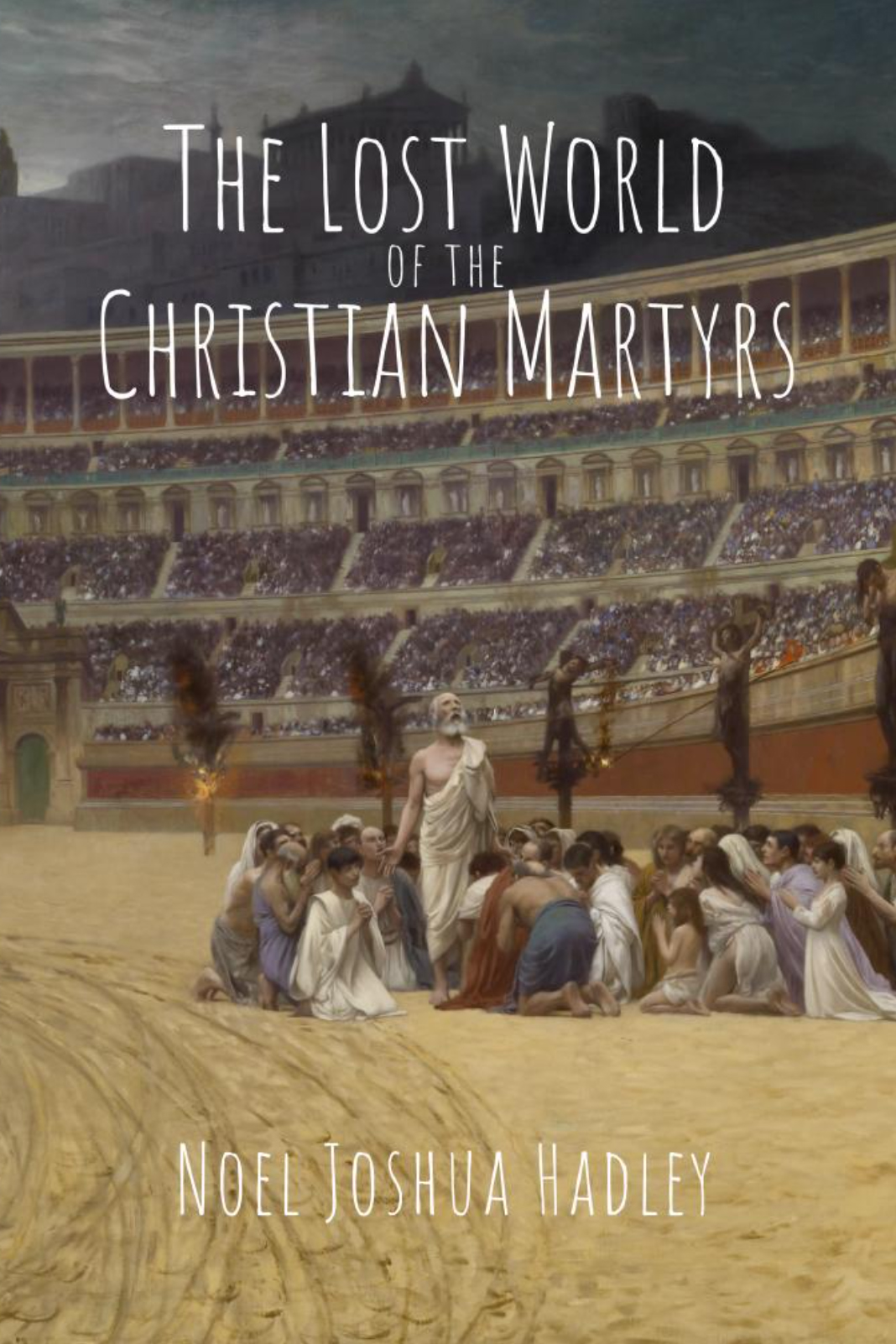
CONTINUING my Lost World series is a curiosity piece intended as a gift from one extra-Biblical aficionado to another. We have arrived at the Lost World of the Christian Martyrs. There will be blood.
The present collection is not complete. You figure there are texts so obscure that their titles have evaded the most devoted collector. Some have never been translated from the Greek, Latin, or Syriac languages. I do happen to stumble upon those every now and then. Jacobus de Voragine has much to say in The Golden Legend but I am saving his life’s work for another potential venture. I would also like to think that other accounts have yet to be rediscovered from the basements of our realm. New texts do spring up on the scholarly market every now and then. YAH willing there will be a second and a third, maybe even a fourth and a fifth edition to this one.
I begin the present collection with the magnum opus of all passion accounts, The Martyrdom of Polycarp. I recall reading somewhere, and it may be true, that Polycarp was the granddaddy of them all, giving birth to and inspiring an entire genre. If you haven’t read Polycarp then you are in for a treat. Prepare yourself. The stories contained within this anthology are so far removed from the modern materialized perception found within the spiritual paradigms of western evangelicalism as to be a truly jarring experience.
Those who criticized Mel Gibson’s The Passion of the Christ due to its emphasis on horror-level gore seem to misunderstand the very genre which the director sought to mimic. The Passion Play for starters. Throughout the Middle-Ages and the early Christian era, the common arc of martyrdom literature asks the writer or the scribe, and presumedly the reader, to bask in the glory of ultimate sacrifice. Picking up one’s cross and following Messiah may not simply involve a choice between hungry beasts, the rack or the wheel, the wooden horse, the fire, the blade, and other gruesome forms of mutilation as a test of your loyalty. Contrarily, it may involve all of them before you are finally beheaded. Lost world, indeed.
The stories contained within have a habit of inciting the imagination. You will encounter the legendary Dogman, Saint Christopher. Modern day skeptics in a materialized Copernican cosmology may balk at the prospect of a cryptid taking the martyrs path, and yet, contemporaries of his account seemingly had little trouble filing it into their accepted reality when gazing about at the realm they inhabited. Just as challenging to our own present sensibilities is the account of the Seven Sleepers of Ephesus, in which young Christian men miraculously managed to evade martyrdom by falling asleep in a cave and waking up after the Latin Kings had converted the Empire to Christianity. News of their miracle became so wide-spread in the Constantinian world that they even made an appearance in the Quran, which is to say, it was believed by many. Washington Irving must have taken notice when writing Rip Van Winkle.
Lastly, I end this present volume with the most horrific mutilation narrative of them all, the highly dramatized Martyrdom of Saint George. Those of you who have contemplated my research into The Seven Thousand Year Timeline Deception and it’s direct follow-up, The Seven Thousand Year Timeline Deception and Saint George, will hopefully recall that I put a lot of work into identifying the legendary dragon slayer. He is Elijah.
If you find yourself contemplating which of these are authentic glimpses of His-Story vs embellished accounts or simply good old fashioned wartime propaganda then I think those are healthy questions to ask. On my part, I am attempting to assemble the most complete picture possible even if the puzzle pieces don’t fit on first glance. I leave it up to you to decide their historical credibility. And what of their Scriptural authenticity if any? Well, I suppose The Martyrdom of Polycarp would hold just as much historical relevance as Susanna or Maccabees in the apocrypha if you want my opinion.
The intent was to make this a short Introduction, and so far, I think I am managing. You will notice that I did not edit most of these texts to compliment Hebrew names like ALAHAYAM or YAHAUAHA. That is because I was not interested in religio-political correctness, desiring rather that each text speak according to the language and custom of its time. For this Intro, what I wanted to mainly focus on is the jarring experience of the martyrdom genre and also to air a breath of caution. The easier route is to close the binding of this book and brush it off by concluding that we are more enlightened in our theology today than the ancients, who apparently had it wrong. Maybe we do and maybe we don’t. There is more to this investigation, however, than simply deciding upon which of us are more correct in the argument.
If you happened to read Ma’asiym: The Continued Acts of the Apostles, then you may have noticed the heavy doses of Docetism in the unfolding narrative. I can’t help but wonder how many of my readers roll their eyes at the thought of Christ being so large and beyond comprehension that he simultaneously embodies a child, a handsome youth, and a deformed person. And yet, The Continued Acts of the Apostles documents a contagious belief in that very notion throughout the early centuries. Whether or not Docetism is a correct position to take in the Mysteries of heaven game is secondary to the apparent fact that, in a tug-of-war of theological ideas between the centuries and cultures, many believed it to be so. That right there has my curiosity.
The Martyrdom genre, like Docetism, did not win the day in the end, but then, how many of us are claiming that we are embracing ‘the faith’ in its true aboriginal form when in fact there are so many puzzle pieces to choose from? I do not say this to throw anyone into confusion. I simply offer martyrdom literature as another component to the lost world many of us are attempting to reassemble and comprehend. I bid adieu and send you off now on your own discovery.
Noel Joshua Hadley
1/28/2026