President Trump said on Monday that he will sign an executive order outlining “one rulebook” when regulating artificial intelligence.
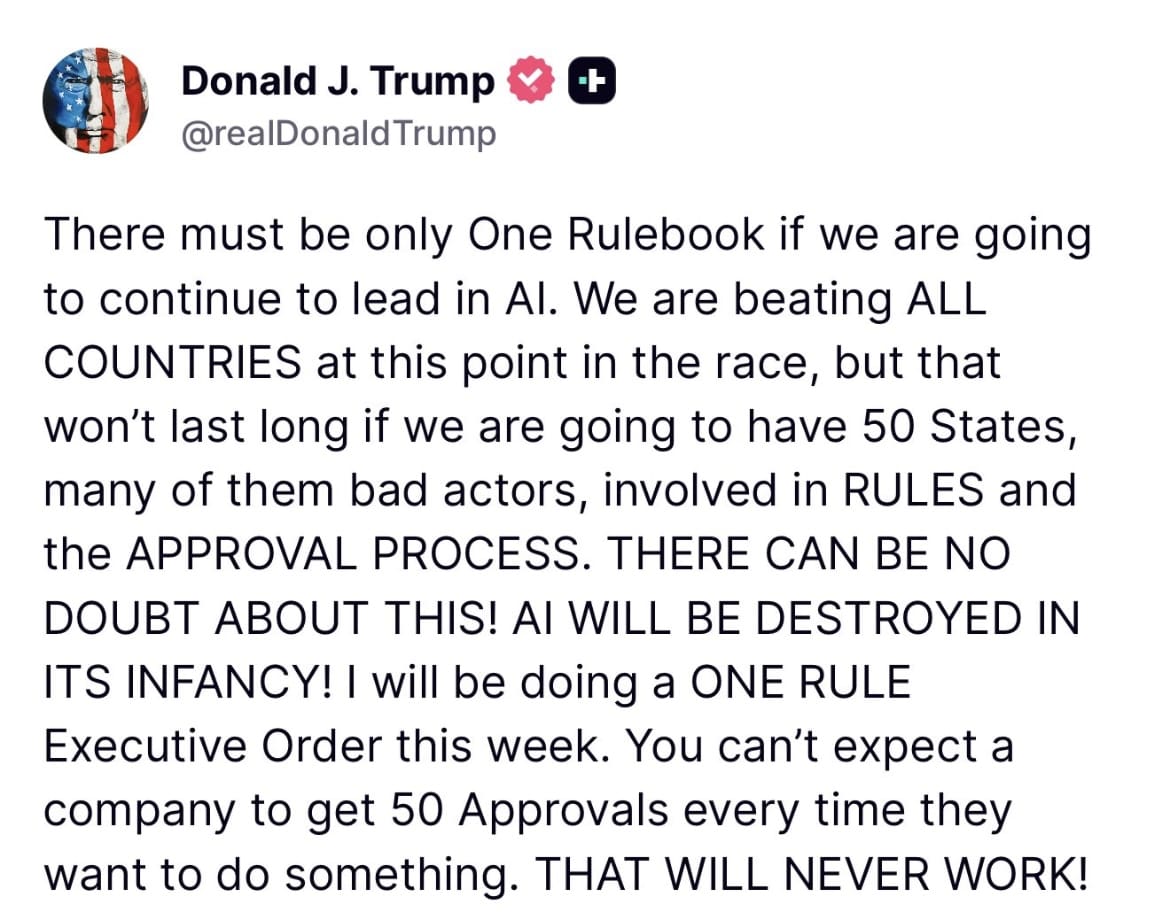
“There must be only One Rulebook if we are going to continue to lead in AI. We are beating ALL COUNTRIES at this point in the race, but that won’t last long if we are going to have 50 States, many of them bad actors, involved in RULES and the APPROVAL PROCESS. THERE CAN BE NO DOUBT ABOUT THIS! AI WILL BE DESTROYED IN ITS INFANCY!” Trump said.
“I will be doing a ONE RULE Executive Order this week. You can’t expect a company to get 50 Approvals every time they want to do something. THAT WILL NEVER WORK!” he added.
The Hill has more:
It’s unclear what the final AI executive order will look like. A draft order seen by The Hill last month would have created a task force dedicated to challenging state AI laws and restricted certain broadband funding for states with AI laws deemed overly burdensome.
The draft emerged in late November, as House GOP leadership was facing pushback over its effort to include a provision that would have barred state AI laws in the National Defense Authorization Act (NDAA).
Republican leaders reportedly urged Trump to hold off on the order, as they continued the last-minute push to add preemption to the must-pass defense bill. However, House Majority Leader Steve Scalise (R-La.) indicated last week that the effort had fallen short, suggesting they were “looking at other places” for the AI provision.
The provision was not included in the final negotiated text of the NDAA released late Sunday.
Last month, Trump signed an executive order to launch a “national effort to use artificial intelligence (AI) to transform how scientific research is conducted and accelerate the speed of scientific discovery.”
“The Genesis Mission charges the Secretary of Energy with leveraging our National Laboratories to unite America’s brightest minds, most powerful computers, and vast scientific data into one cooperative system for research,” the order read.
“The Order directs the Department of Energy to create a closed-loop AI experimentation platform that integrates our Nation’s world-class supercomputers and unique data assets to generate scientific foundation models and power robotic laboratories,” it continued.
“With this pen today, President Trump signed an historic mission. This is reminiscent of the Manhattan Project that brought World War II to an early and successful end, similar to the Apollo projects that put a man on the moon in 1969,” Secretary of Energy Chris Wright said.
“This is an all-in national effort to take the power of AI and pair it with the 40,000 outstanding scientists and engineers at our national labs, to use the world’s largest supercomputers to advance innovation and science, to fix our rising energy costs, to give better economic opportunities for our citizens, to make longer and healthier lives possible,” he continued.
Footage below:
BREAKING: President Trump just signed an executive order akin to the MANHATTAN PROJECT that will deploy 40,000 THOUSAND USA scientists and engineers for the rapid advancement of AI over our competitors
SEC. CHRIS WRIGHT: “With this pen today, President Trump signed an… pic.twitter.com/V6mxQbARVR
— Eric Daugherty (@EricLDaugh) November 24, 2025

Fox Business shared:
Trump declared last month that the U.S. “MUST have one Federal Standard instead of a patchwork of 50 State Regulatory Regimes,” and argued that over regulation at the state level was threatening the investment, and expected growth, of AI.
On Sunday, Google CEO Sundar Pichai made a call for national AI regulation to compete with China more effectively during an interview on “Fox News Sunday.”
Pichai said that more than 1,000 AI-related bills currently moving through state legislatures could create confusing rules that make it harder for U.S. companies to compete globally.
“How do you cope with those varied regulations, and how do you compete with countries like China, which are moving fast in this technology?” Pichai questioned. “So I think we have to get the balance right.”