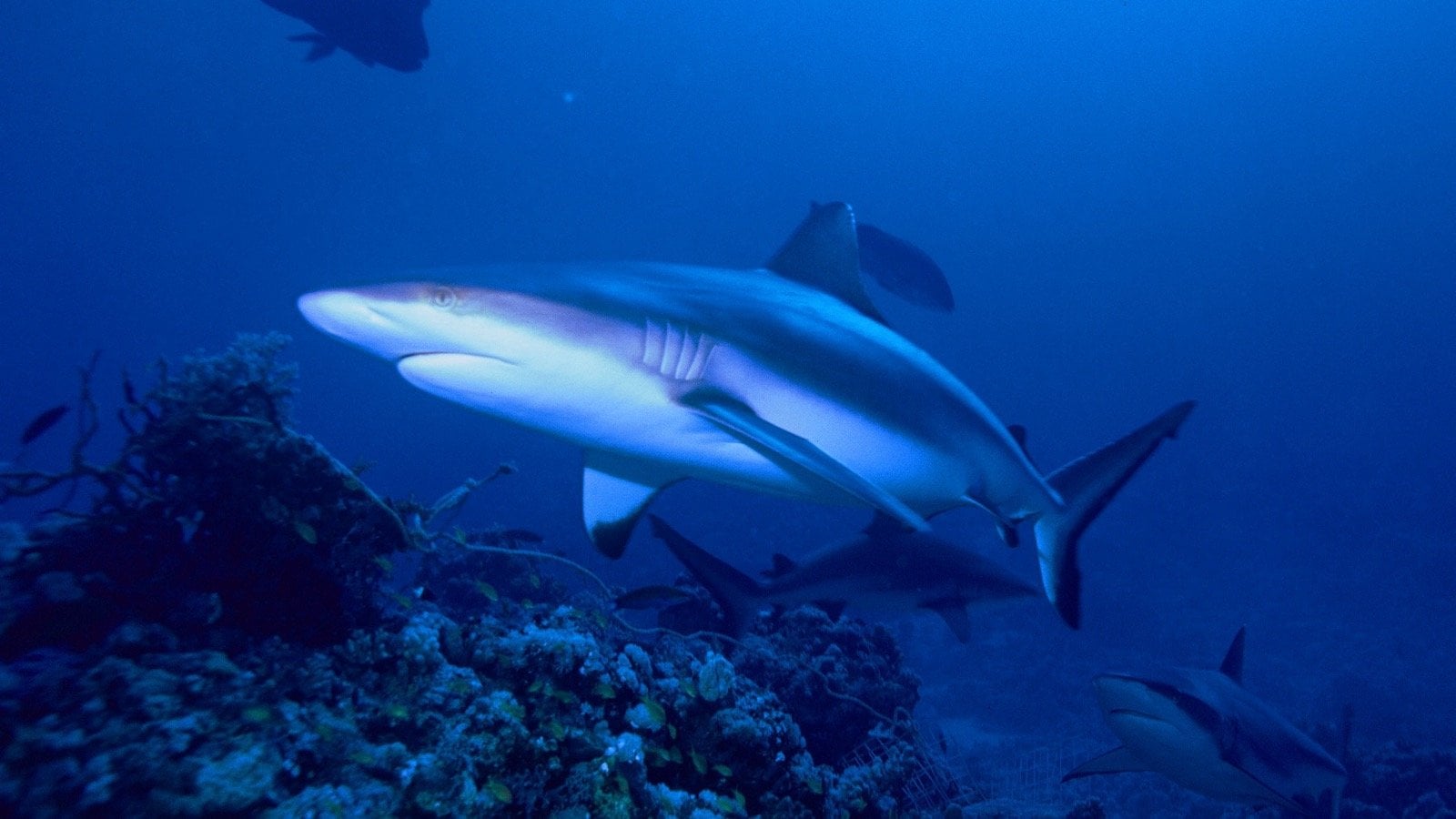
Henry Gibbs knew the grey reef shark was coming for him.
It had already begun making tight semicircles beneath the spearfishers. Then it grew more agitated and made a fast run toward their boat.
Gibbs saw the warning signs, but he did not believe a shark of that size posed a serious threat.
Seconds later, his camera was recording a fight to keep his leg.
Warning: The footage below contains graphic content.
The terrifying encounter was captured from Gibbs’s point of view:
In his first-person account on Instagram, Henry Gibbs said the group had spent an hour or two diving along a reef in Fiji before moving into clearer blue water in search of larger fish.
They had missed several shots, and a handful of grey reef sharks were nearby. One stayed with the group longer than the others.
Gibbs said the commotion from the boat, the spearguns, and activity in the water may have made the shark more interested or excited. He stressed that he will never know exactly what caused the change.
What he does know is that the shark’s behavior changed before the attack. It circled more tightly, became erratic, and rushed the boat.
Looking back, Gibbs believes that was the moment to end the dive.
Instead, he remained in the water. His experience with generally less aggressive sharks in New Zealand had given him a false sense of security.
“I knew it was coming for me,” Gibbs wrote.
The shark slipped past his speargun, moved underneath him, clamped onto the back of his right calf, and began to death roll. The image lurches into chaos as Gibbs fights in the water.
His companions, Colby and Dan, got him out. They controlled the bleeding and rushed him toward medical care.
People reported on July 24 that the New Zealand fishing creator suffered major injuries to his right leg during what was his first dive in Fiji.
The update was Gibbs’s first Instagram post in roughly two weeks. It included hospital photos and his account of the two friends pulling him from the water quickly enough to get him urgent treatment.
Gibbs later credited Colby and Dan with helping him survive the emergency. At the hospital, he underwent four surgeries and received a skin graft.
Despite the damage, Gibbs said he still had full use of his foot and expected to make a full recovery. He also said he held no grudge against the shark because he had entered its environment while hunting its food.
The report identified Gibbs as an outdoor and fishing creator with more than 100,000 combined followers across Instagram and TikTok. His recovery was still underway when he released the footage, but his outlook was strikingly positive after an injury that could have cost him his leg.
Before Gibbs released the attack footage, an earlier recovery report documented the severe wound to his lower leg.
It showed Gibbs in the hospital and described the support surrounding him as he prepared to share the video. At that point, the public had seen the aftermath but not the split-second attack that caused it.
Here is the earlier recovery report:
The behavior Gibbs described is not something spearfishers can afford to dismiss.
The University of Florida’s International Shark Attack File says many recorded spearfishing incidents involve a shark investigating the diver for several minutes before anything happens.
Sudden rushes do occur, and the organization says those incidents may involve territorial defense. More commonly, vibrations from a wounded fish and blood in the water bring a shark closer to the person or the catch.
Many bites happen while a spearfisher is trying to defend a fish. That is why the guidance says catches should not be carried on a belt stringer or against the diver’s body.
The organization advises spearfishers to dive with a buddy, stop a caught fish from vibrating, and move the catch to a boat or land between shots when possible.
If a shark approaches, the recommendation is to maintain eye contact and move slowly toward an exit. If it attempts to bite, the diver may need to strike sensitive areas such as the eyes or gills while continuing to get out of the water.
The Florida Museum describes grey reef sharks as inquisitive animals that commonly approach divers. When threatened or cornered, they can show a distinct warning display through sharp movements, an arched back, lowered pectoral fins, and exaggerated swimming.
The species is a powerful reef predator that can grow to roughly six or seven feet long. It favors tropical and subtropical waters around coral atolls, lagoons, reef flats, and steep reef drop-offs.
Grey reef sharks often gather during the day and hunt alone at night. They are known for approaching divers out of curiosity, but the museum warns that a threatened animal may deliver a rapid bite before retreating.
The threat display is the detail that stands out in Gibbs’s account. He still cannot say exactly what triggered the attack, and the sudden behavior change mattered far more than the animal’s size.
Divers Alert Network also advises ending a dive when sharks become intensely interested in the fishing activity.
Its spearfishing guidance stresses advance planning with buddies and boat crews, keeping first-aid supplies for severe bleeding nearby, and making sure someone knows how to use a tourniquet if hospital care may be delayed.
Divers are told to keep the shark in view because it may disappear and reappear from a different direction. If a caught fish has drawn the animal in, giving up the catch may be the safest move.
The network also emphasizes removing an injured person from the water, applying direct pressure to severe bleeding, and stabilizing the victim for emergency transport. Those preparations are not dramatic until the second they become the only thing standing between a badly injured diver and disaster.
Gibbs came away with the same lesson in the most brutal way possible.
Watch the animal’s behavior. Do not underestimate a smaller shark.
Carry real trauma gear. Dive with people you trust.
He is alive, he still has his leg, and his doctors expect him to recover.
The footage is terrifying. The warning signs before it may be the part that saves someone else.
This is a Guest Post from our friends over at WLTReport. View the original article here.
The post WATCH: Spearfisher Henry Gibbs Saw The Grey Reef Shark Coming. Then It Made Its Move appeared first on 100PercentFedUp.com.