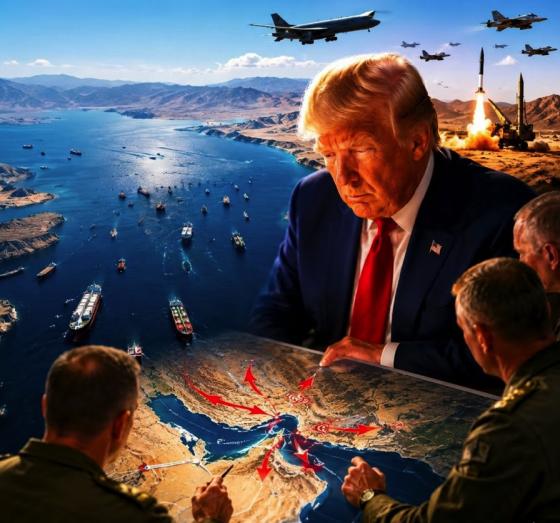
 The crisis in the Strait of Hormuz is not even close to being resolved, and global oil supplies continue to get tighter and tighter. The world has been running an “oil deficit” for months, and we have been able to do that by running down commercial oil inventories and strategic national reserves. There was hope that traffic through the Strait of Hormuz would return to pre-war levels before things got really hairy, but that isn’t happening. In fact, in recent days only about 30 to 40 commercial vessels have been traveling through the Strait each day. Before the war, the average was about 120 to 130 commercial vessels per day. The vast majority of the commercial vessels that have been getting through the Strait have been heading away from the Persian Gulf. Very few are headed into the Persian Gulf for understandable reasons. So once the backlog of commercial vessels that have been trapped in the Persian Gulf is finally eliminated, the level of traffic through the Strait of Hormuz will likely drop to depressingly low levels.
So we should be thankful that the price of oil has dropped a bit lower for now, but it won’t stay that way.
And that will especially be true if war with Iran fully erupts again.
We have seen fighting flare up multiple times in recent weeks, and it certainly wouldn’t take much to push things over the edge.
On Wednesday, it was being reported that President Trump has been briefed on options for “a return to all-out war with Iran”…
President Trump has weighed a return to all-out war with Iran, holding multiple conversations in recent days with Defense Secretary Pete Hegseth and Chairman of the Joint Chiefs of Staff Gen. Dan Caine on more strikes, but has decided to stick with diplomatic talks for now, according to U.S. officials familiar with the discussion.
The conversations have centered on whether the U.S. should abandon negotiations and resume full-scale attacks on Iran, the officials said, a move some of them describe as “finishing the job.” While not making a final decision, Trump has told aides he believes another round of full-scale attacks could derail diplomacy and hurt Washington’s chances of ultimately dismantling Iran’s nuclear program.
I was quite surprised when I read that.
I didn’t think that Trump and his team had an appetite for more conflict right now.
Meanwhile, Iranian Foreign Minister Abbas Araghchi just used some very strong language in an extremely inflammatory social media post…
The terms of the Islamabad MoU are crystal clear and public for all to see.
POTUS has committed the U.S. to muzzling its pets in Tel Aviv. If they ignore their master, Iran will school them.
Any threat against our People and Leadership will receive Immediate Powerful Response.
This is a threat to attack Israel.
The Iranians are demanding that the Israelis must withdraw from Lebanon, but the Israelis continue to tell us that this will simply not happen…
Israel’s defense minister said Wednesday that forces would remain “indefinitely” in so-called security zones established in Lebanon, Syria and the Gaza Strip.
“The IDF will not withdraw and will remain in the security zones in Lebanon, Syria, and Gaza – indefinitely – to protect our residents and communities from jihadist elements,” Israel Katz said.
“We are fighting to change reality and bring security to the residents of the north,” he added, referring to communities along Israel’s border with Lebanon from which thousands of people have been evacuated due to the threat posed by Iranian-backed Hezbollah.
The Israelis are absolutely determined to stop the bombardment of their northern communities.
Since early March, Hezbollah has fired “more than 7,000 rockets, missiles and drones” into Israeli territory…
Israeli officials say Hezbollah has launched more than 7,000 rockets, missiles and drones into Israel since early March while embedding military infrastructure inside civilian areas and Christian villages in southern Lebanon.
The claims were made by Israeli Foreign Minister Gideon Sa’ar during MUNI EXPO in Tel Aviv as Israel, Lebanon and the United States continue negotiations aimed at securing Hezbollah’s disarmament and a lasting peace agreement.
“Since March alone, Hezbollah has launched more than 7,000 rockets, missiles and drones from Lebanese territory into Israel,” Sa’ar said. “What country can accept this and not act to restore security to its citizens?”
It is inevitable that Hezbollah will fire more rockets, missiles and drones into northern Israel.
In response, Israel will bomb southern Beirut again.
The Iranians have already told us that if Israel does that again they will fire ballistic missiles at Israel.
And once that occurs, the IDF will strike back extremely hard.
I don’t know what those that are convinced that there will be peace in the Middle East are smoking, but it must be really strong.
When more fighting erupts in the Middle East, traffic through the Strait of Hormuz will drop lower than it is now.
And that is very bad news, because even though the “Memorandum of Understanding” was signed a couple of weeks ago, traffic through the Strait of Hormuz continues to remain at very low levels…
Shipping traffic through the Strait of Hormuz began to rebound Monday following weekend tit-for-tat strikes between the U.S. and Iran.
Reports from the maritime tracking firm Kpler said 40 vessels passed through the critical waterway on Monday, while 24 ships transited the strait on Sunday in addition to 39 ships on Saturday.
Almost all of the commercial vessels that are passing through the Strait are headed out.
Very few are headed in.
And many of the ships that are actually headed in are Iranian.
For now, most shipping companies continue to treat the Strait of Hormuz “as a war zone”…
Unions and shipping employers said in a statement Wednesday they will continue to designate the Strait of Hormuz as a war zone until at least July 9, maintaining double pay for seafarers in the area despite a fragile truce between the U.S. and Iran.
The status only covers ships whose companies are signatories of the International Bargaining Forum’s labor agreements — around 15,000 vessels worldwide, according to the IBF.
Seafarers covered by the agreement working on ships in the Strait of Hormuz and its surrounding waters get paid double, and have the right to refuse to sail into the area and request repatriation at the company’s expense, increasing costs for shipping companies.
This is really bad news for the global economy.
On top of everything else, Ukraine’s endless bombardment of Russian oil facilities has caused gasoline shortages all over Russia…
Fuel shortages across Russia have triggered a new political challenge for President Vladimir Putin, as a relentless Ukrainian drone campaign aimed at the country’s oil refineries has brought the war home for most ordinary Russians.
While Ukraine has targeted Russian energy facilities for years, the quantity and firepower of Ukrainian drones and missiles have risen. This has allowed Kyiv to hit refineries as far as Tyumen, 1,200 miles away in Siberia, and permitted the spectacular raid that broke through thick layers of air defenses and destroyed Moscow’s main refinery on June 18, the turning point of the current crisis.
Some 28% of Russia’s refining capacity was offline as of June 20, estimated Sergey Vakulenko, former head of strategy at Gazprom Neft, a large Russian oil company, and now a senior fellow at the Carnegie Russia Eurasia Center in Berlin.
Russia is one of the largest oil producers on the entire planet.
But now the Russians are being forced to actually import fuel thanks to Ukraine.
Everything that I have shared in this article means that global supplies of oil are going to continue to become tighter and tighter in the weeks and months ahead.
In other words, the stage is being set for a severe global energy crisis and a mammoth global economic meltdown.
For the moment, many investors are still feeling very optimistic about things, but it won’t be too long before they are brutally blindsided by reality.
Michael’s new book entitled “10 Prophetic Events That Are Coming Next” is available in paperback and for the Kindle on Amazon.com, and you can subscribe to his Substack newsletter at michaeltsnyder.substack.com.

About the Author: Michael Snyder’s new book entitled “10 Prophetic Events That Are Coming Next” is available in paperback and for the Kindle on Amazon.com. He has also written nine other books that are available on Amazon.com including “Chaos”, “End Times”, “7 Year Apocalypse”, “Lost Prophecies Of The Future Of America”, “The Beginning Of The End”, and “Living A Life That Really Matters”. When you purchase any of Michael’s books you help to support the work that he is doing. You can also get his articles by email as soon as he publishes them by subscribing to his Substack newsletter. Michael has published thousands of articles on The Economic Collapse Blog, End Of The American Dream and The Most Important News, and he always freely and happily allows others to republish those articles on their own websites. These are such troubled times, and people need hope. John 3:16 tells us about the hope that God has given us through Jesus Christ: “For God so loved the world, that he gave his only begotten Son, that whosoever believeth in him should not perish, but have everlasting life.” If you have not already done so, we strongly urge you to invite Jesus Christ to be your Lord and Savior today.
The post Traffic Through The Strait Of Hormuz Is Way Below Pre-War Levels As Trump Is Briefed On Options For “All-Out War” appeared first on The Economic Collapse.