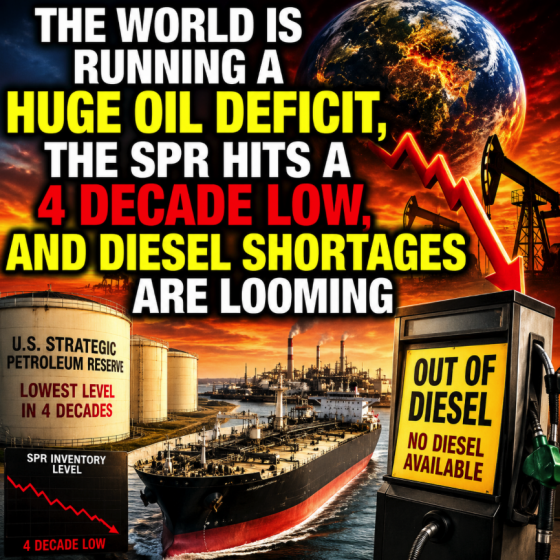
 The world is barreling toward a historic energy crunch that will be unlike anything that we have ever seen before. When fighting with Iran erupted earlier this year, the global economy was absolutely swimming in oil. We literally had far more oil than we needed, but now commercial inventories have gotten extremely tight and national reserves are alarmingly low. If the Strait of Hormuz does not get reopened soon, we will quickly enter an immensely painful chapter of the global energy crisis. Energy prices will shoot way up and shortages will start to become a major issue. In fact, a global scramble for supplies of diesel fuel has already begun.
Right now the world is consuming far more oil than it is producing.
We have been running an enormous oil deficit for months, and the amount of oil that is coming out of the Persian Gulf is running at about half of pre-war levels…
Wall Street analysts – who use ship tracking services like Kpler and Windward Intelligence, among many other data points, to provide estimates about oil flows – have said oil tankers have been getting roughly 4 million barrels of oil out of the Persian Gulf each day.
In addition to the roughly 7 million barrels per day that Middle Eastern countries have rerouted around the strait through pipelines and other methods, about 11 or 12 million barrels have been flowing out, according to the tracking services. That’s significantly lower than the 20 million barrels per day that the region had exported before the Iran war started.
We have been able to operate normally all this time because there was a tremendous amount of excess oil sitting around.
But now somewhere between 1.5 and 1.9 billion barrels of excess oil have disappeared…
Global inventories are between 1.5 billion and 1.9 billion barrels lower now than they were at the start of the war, depending on who’s estimating. Massive crude stockpiles before the war helped prevent catastrophe when supply dried up.
Commercial oil inventories are exceedingly tight at this stage.
The good news is that there is still some extra oil remaining in the Strategic Petroleum Reserve.
The bad news is that the amount of oil in the Strategic Petroleum Reserve is now so low that we risk doing permanent damage if we continue to drain the salt caverns where the oil is stored…
The caverns that hold the U.S. strategic oil reserve could get damaged by the rapid release of stockpiles in response to the Iran war, experts warned this week as inventories hit a four-decade low.
Damage to the caverns would make it more difficult to respond to future energy emergencies, the experts said. The oil in the Strategic Petroleum Reserve, or SPR, is stored at 60 salt caverns thousands of feet underground at four major sites along the Gulf Coast in Louisiana and Texas.
300 million barrels is considered to be a danger point by many industry insiders.
We have now gone beyond that level…
The SPR has tumbled below 300 million barrels for the first time since it was filled in the early 1980s, according to Department of Energy data released Monday. Inventories are depleting as the U.S. releases 172 million barrels in response to the supply disruption caused by the Iran war. The SPR will sit at around 243 million barrels after the drawdown is finished.
To extract oil from the Strategic Petroleum Reserve, operators pump water into the bottom of the underground caverns.
This pushes the crude oil to the surface and into the pipelines.
However, the caverns must always maintain a strict minimum of 70 million barrels.
This cushion keeps the extraction pipes safely submerged in oil instead of drawing up water.
Officials in Washington are insisting that we can safely keep removing oil out of the SPR until we reach the 70 million barrel mark.
But one expert is warning that such a claim is “nonsense”…
“Don’t believe the people out of the government that are saying the SPR can go to 70 million barrels. It’s nonsense,” Hochstein told CNBC’s “Squawk Box” on Thursday. At that level, the reserve would be depleted to “the point of never resurrecting it,” he said.
Depleting the reserve below 300 million barrels risks damage to the caverns, the former Biden administration official warned in June.
“I don’t know anyone who believes we can go below 300,” Hochstein told CNBC’s Brian Sullivan at an Atlantic Council event. “I know plenty of people who think we can’t get near 300 because physically you will damage the caverns where the oil is stored.”
We have now gone under the 300 million barrel mark.
And I think that we will continue to draw down the SPR because there is no much pressure to do so.
But the clock is ticking.
Eventually we won’t be able to get any more oil out of the SPR.
What will we do then?
Will we start seeing lines at gasoline stations?
That is precisely what we are witnessing in Russia right now.
In fact, another wave of fuel shortages has just hit that nation…
Fuel shortages have returned to some regions of Russia in August, prompting local authorities in at least 10 regions to again tighten controls on sales of motor fuel at petrol stations, according to authorities and regional media.
Reuters witnesses reported on Monday that gasoline was once again unavailable at some fuel stations in the Moscow region, although diesel fuel was available at almost all stations.
The fuel crisis, which began gaining momentum in May and by July had spread to almost all regions of Russia, follows the shutdown of several refineries hit in drone attacks and a seasonal rise in demand.
Russia is normally the second largest exporter of diesel fuel in the world.
But now they are being forced to hoard what they have.
So this is starting to make things very difficult in Europe and Asia.
In fact, European countries are now scrambling to find sufficient supplies of diesel fuel…
Diesel cargoes are costing more than jet fuel in Europe for the first time in more than a year, LSEG data showed, as the continent replaces lower Middle East air fuel shipments with other sources of supply, but struggles to secure more diesel for industry and agriculture.
Europe has been able to pull in jet cargoes from the U.S. and other countries like Nigeria as prices surged after the start of the Iran war, which disrupted crude and fuel supply. Global diesel supply tightened even further when Russia banned exports amid Ukrainian attacks on its refineries.
“We see a higher risk of persistent scarcity pricing in diesel than in crude heading into winter,” analysts at Goldman Sachs said in a note.
We were warned that this would happen, and now it is happening.
Here in the United States, diesel prices are really starting to spike…
In the United States, the report said, diesel futures booked their sharpest rise since July on Monday, adding 7.4% to $4.19 per gallon. The average retail price for a gallon of diesel was $5.32 on Tuesday, according to AAA data. That was up from $4.88 per gallon a month ago and $3.71 per gallon a year ago. To put it mildly, this is problematic.
Diesel is often referred to as the workhorse of any economy. Indeed, economies run on diesel, which is used for everything from freight transportation to farming, to heating during the winter. If diesel prices are consistently higher for an extended period of time, they will inevitably be passed on to consumers, fueling a more generalized inflation trend.
We produce more diesel than anyone, and so for the moment we are okay.
But higher diesel prices will directly affect the cost of living for every single one of us.
And if the Strait of Hormuz does not get reopened, things will get a lot worse.
For now, the Iranians are insisting that the Strait of Hormuz will remain closed until President Trump agrees to every single one of their outrageous demands.
President Trump can never do that, because giving in to every single one of their outrageous demands would make him look like an all-time loser.
So it appears that we are stuck between a rock and a hard place, and the global energy crisis is poised to greatly accelerate in the months ahead.
Michael’s new book entitled “10 Prophetic Events That Are Coming Next” is available in paperback and for the Kindle on Amazon.com, and you can subscribe to his Substack newsletter at michaeltsnyder.substack.com.

About the Author: Michael Snyder’s new book entitled “10 Prophetic Events That Are Coming Next” is available in paperback and for the Kindle on Amazon.com. He has also written nine other books that are available on Amazon.com including “Chaos”, “End Times”, “7 Year Apocalypse”, “Lost Prophecies Of The Future Of America”, “The Beginning Of The End”, and “Living A Life That Really Matters”. When you purchase any of Michael’s books you help to support the work that he is doing. You can also get his articles by email as soon as he publishes them by subscribing to his Substack newsletter. Michael has published thousands of articles on The Economic Collapse Blog, End Of The American Dream and The Most Important News, and he always freely and happily allows others to republish those articles on their own websites. These are such troubled times, and people need hope. John 3:16 tells us about the hope that God has given us through Jesus Christ: “For God so loved the world, that he gave his only begotten Son, that whosoever believeth in him should not perish, but have everlasting life.” If you have not already done so, we strongly urge you to invite Jesus Christ to be your Lord and Savior today.
The post The World Is Running A Huge Oil Deficit, The SPR Hits A 4 Decade Low, And Diesel Shortages Are Looming appeared first on The Economic Collapse.