OpenAI Says Not to Worry About UBI, Because It Has Another Idea

Uncategorized

As AI companies warn of mass automation and the end of work as we know it, ChatGPT maker OpenAI has published a sweeping policy paper outlining its vision of who should call the shots once “superintelligent AI” goes online.

Beneath the paper’s flowery rhetoric is something familiar: a powerful corporation arguing that the best way to provide for the poorest people in the world is to let the richest do whatever they want.

The paper starts off by warning — ironically — that superintelligent AI could concentrate wealth among a small number of companies. Its solution to this problem, at a time when nearly 48 million Americans already struggle with hunger, is a “public wealth fund,” which would be a program that provides “every citizen” with a “stake in AI-driven economic growth.”

Instead of expanding tested programs like a universal basic income or unemployment insurance, in other words, OpenAI’s proposal is to hitch the public’s wellbeing to the boom-and-bust cycles of the tech industry.

“Policymakers and AI companies should work together to determine how to best seed the fund, which could invest in diversified, long-term assets that capture growth in both AI companies and the broader set of firms adopting and deploying AI,” the paper suggests. “Returns from the fund could be distributed directly to citizens, allowing more people to participate directly in the upside of AI-driven growth, regardless of their starting wealth or access to capital.”

Of course, in a market economy constant growth isn’t guaranteed, even if we do somehow achieve superintelligence. What happens if the tech companies suddenly post a bad quarter? What if our incredible AI system decides to take over Wall Street?

What workers need isn’t a wealth fund indexed to tech industry profits. They need universal healthcare, access to fresh food, and housing that isn’t tied to the ebbs and flows of the stock market. Unlike AI superintelligence, this isn’t a utopian fantasy. It’s the baseline that most wealthy democracies already provide — no AI required.

More on OpenAI: Inside Sources Say Sam Altman Is a Sociopath

The post OpenAI Says Not to Worry About UBI, Because It Has Another Idea appeared first on Futurism.

Acts 28 ends abruptly and that’s never sat right with me. With the inclusion of Acts 29, we are given a nice well-rounded finale to Luke’s biography and some interesting closure to Pontius Pilate as well. Join me as I continue my Lost Books of the Bible series on YouTube, reading from Acts 29, 3 Corinthians, and the Phoenix of Tertullian.

You can read along with these texts and more on our Sacred Scripture page. 

IN the summer of 2019, I was seated in the wine cellar of a walled Medieval town high above the Dordogne Valley of France, not far from Sarlat-la-Canéda, making phone calls, writing reports. I have given this story in other places and it appears as though you’re about to hear it again. Rob Skiba is a name you that you might be familiar with. Though he had made a name for himself as a Nephilim researcher, more recently Rob had taken a dive into the deep end of the pool via flat earth research. The recorded interviews I conducted between he and Rick Hummer, a fellow flat earth investigator and close friend of his, was published while still occupying that very wine cellar. Read all about it. Chicago Is Not a Mirage.

Word quickly spread. Within a few short weeks, dozens of flat earth researchers began accepting my invite for a private interview, if not a series of interviews. From a 17th-century tower built by King Louis XIV, and with a stunning view of the Alps, I sat down with Robbie Davidson, founder of the Flat Earth International Conferences, conducting multiple sessions. While staying in Dumfries, Scotland, David Weiss agreed to take part in the interviews, as did Bob Knodel of Globebusters. There were others. But when I asked the interviewees to discuss the moments that shaped their lives, among the many PSYOPs, false flag attacks, and hoaxes that were discussed, only these men committed commentary to the false 9/11 narrative.

The resulting recordings ballooned into The Unexpected Cosmology, a book which became a website and was even intended as an anthology. And of course, the following discourse was originally a chapter. It was Walt Disney who stated, “Disneyland will never be completed. It will continue to grow as long as there is imagination left in the world.” Those sentiments remain applicable here as well. American Sensationalism: The 9/11 Interviews was always intended to be expanded upon with the inclusion of new researchers. So I’m sorry to say the project became stagnant during the Covid-19 psychodrama. I took a break to tackle other projects. We lost Rob Skiba. Rob offered hours of private conversation regarding his life but we never got around to the big one. 9/11. It was in the cards. Sadly, Bob Knodel died soon afterwards. Voices are being squeezed from an entire generation. Gnosis passes with them.

In the aftermath, the FE community became fractured. People began going their separate ways. Robbie Davidson, among a noted few others who were interviewed for the project, got up and left the movement altogether. It is not my intent to erase his or the contributions of others if only brief. They came, they went, their testimonies remain.

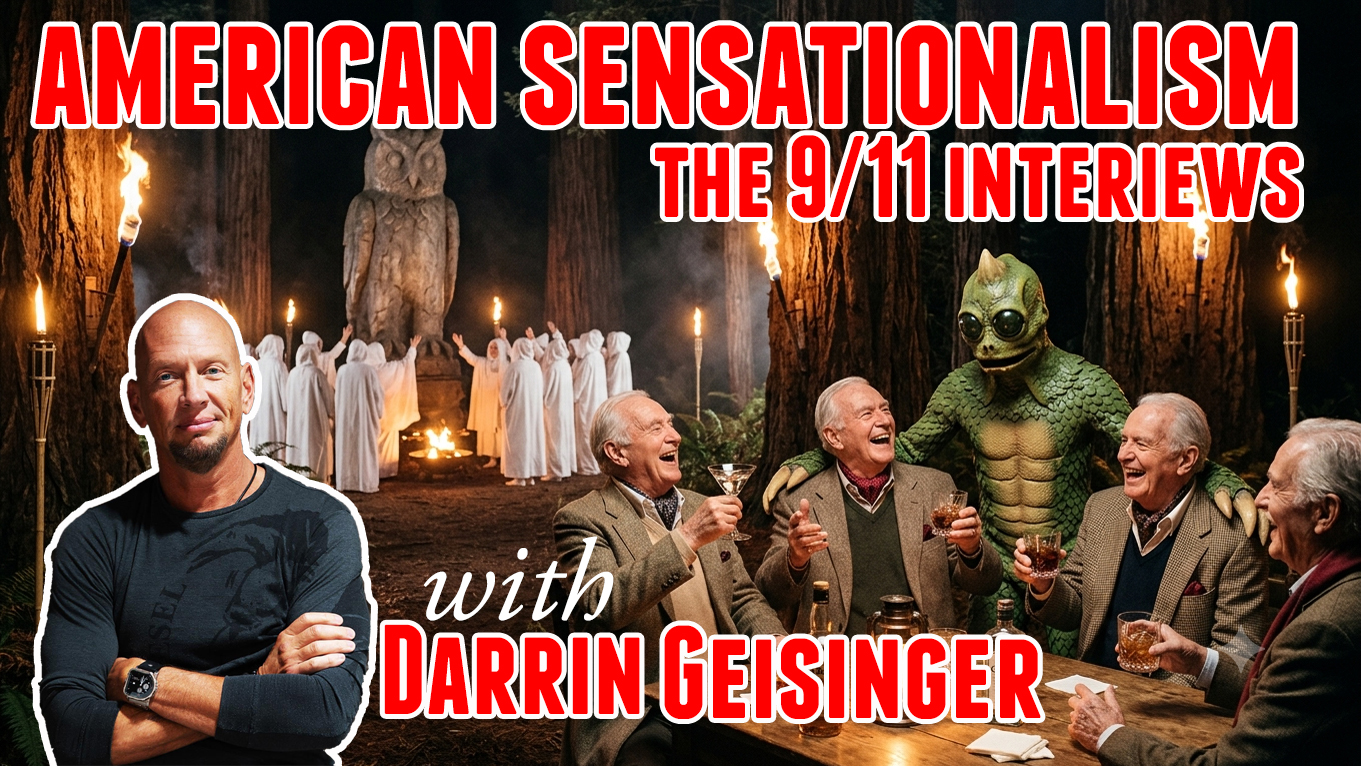
The original vision may have hit roadblocks but it is not forgotten. I expanded this paper a few years later to include testimony from author Pauly Hart, a dear friend of mine. I had wanted to continue that trend every year thereafter but you know how it goes. For the 25th anniversary of the attack I have redirected my efforts to its first large scale expansion, including Andrew Hoy and Darrin Geisinger into the mix. Perhaps others will lend their experiences to the recorder in time.

The following is their report.

Watch the Interviews