Nike’s AI Designed World Cup Jerseys Are a Disaster

Uncategorized

Is there anything about this upcoming World Cup — which will be taking place across the entire continent of North America — that isn’t shaping up to be a total disaster?

FIFA seems to be nakedly price gouging fans on ticket prices, and may have even outright scammed them on the seats they overpaid for. President Trump threatened to deploy ICE agents at World Cup cities and stadiums. US airports have descended into chaos as hundreds of TSA workers quit after working weeks without pay amid a partial government shutdown.

Now, adding to the chaos, Nike’s newly debuted collection of World Cup kits — which were reportedly made with the help of AI — has turned out to be a sartorial catastrophe.

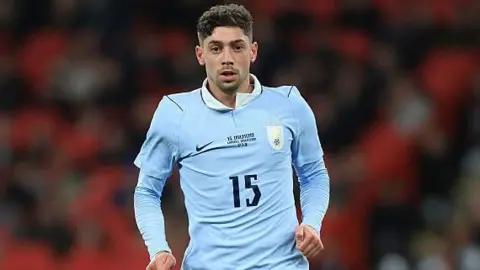
As The Guardian reported, eagle-eyed fans noticed that the jerseys sported by their favorite athletes, including France’s megastar Kylian Mbappé, looked egregiously misshapen. Their fit physiques were overshadowed by a strange bulge on their shoulder seams where the fabric bunched together, as if the shirts took on a life of their own, tried to grow epaulettes, and gave up.

The strangely unnatural silhouette leaves plenty of questions unanswered. Nike manufactures the kits for numerous national teams, including England, France, the US, and Uruguay, and has done so for decades. Uruguay’s seemed to be the worst off, with captain Federico Valverde made to look like he was wearing a jersey three sizes too small during a game against England. How could this happen?

Nike has placed a lot of emphasis on its new “Aero-FIT” design that’s supposed to help athletes keep cool during what’s anticipated to be a scorching hot tournament. It supposedly “leverages computational design and a highly specialized, stich-specific knitting process,” marketing copy states. If “computational design” sounds like a euphemism for AI, you might be on to something. A source familiar with the design process told The Guardian that it involves using elements of AI to work alongside its human designers, raising the possibility that an AI tool may have been involved in the flub.

The athletic apparel maker acknowledged the shoulder bulge issue in a statement to The Guardian, but didn’t address how it occurred.

“During the recent international break, we observed a minor issue with our Nike national team kits, most noticeable around the shoulder seam,” a Nike spokesperson said. “Performance is unaffected, but the overall aesthetic is not where it needs to be,” they added, as if describing some sort of race car.

Athletes weren’t the only ones made to look ridiculous. So too were the many fans that paid up to $200 to buy the Nike jerseys, who fumed about their poor quality on social media.

“The way the shoulders are sewn together just makes them bunch like this no matter what,” one complained on Reddit. “This is a stupid, STUPID design.”

The World Cup is only months away, and possibly millions of these jerseys have already been sold to fans or given to national teams. It’s unclear how, or if, Nike will be able to redesign the kits in time.

More on AI: OpenAI Says Not to Worry About UBI, Because It Has Another Idea

The post Nike’s AI Designed World Cup Jerseys Are a Disaster appeared first on Futurism.
IN the summer of 2019, I was seated in the wine cellar of a walled Medieval town high above the Dordogne Valley of France, not far from Sarlat-la-Canéda, making phone calls, writing reports. I have given this story in other places and it appears as though you’re about to hear it again. Rob Skiba is a name you that you might be familiar with. Though he had made a name for himself as a Nephilim researcher, more recently Rob had taken a dive into the deep end of the pool via flat earth research. The recorded interviews I conducted between he and Rick Hummer, a fellow flat earth investigator and close friend of his, was published while still occupying that very wine cellar. Read all about it. Chicago Is Not a Mirage.

Word quickly spread. Within a few short weeks, dozens of flat earth researchers began accepting my invite for a private interview, if not a series of interviews. From a 17th-century tower built by King Louis XIV, and with a stunning view of the Alps, I sat down with Robbie Davidson, founder of the Flat Earth International Conferences, conducting multiple sessions. While staying in Dumfries, Scotland, David Weiss agreed to take part in the interviews, as did Bob Knodel of Globebusters. There were others. But when I asked the interviewees to discuss the moments that shaped their lives, among the many PSYOPs, false flag attacks, and hoaxes that were discussed, only these men committed commentary to the false 9/11 narrative.

The resulting recordings ballooned into The Unexpected Cosmology, a book which became a website and was even intended as an anthology. And of course, the following discourse was originally a chapter. It was Walt Disney who stated, “Disneyland will never be completed. It will continue to grow as long as there is imagination left in the world.” Those sentiments remain applicable here as well. American Sensationalism: The 9/11 Interviews was always intended to be expanded upon with the inclusion of new researchers. So I’m sorry to say the project became stagnant during the Covid-19 psychodrama. I took a break to tackle other projects. We lost Rob Skiba. Rob offered hours of private conversation regarding his life but we never got around to the big one. 9/11. It was in the cards. Sadly, Bob Knodel died soon afterwards. Voices are being squeezed from an entire generation. Gnosis passes with them.

In the aftermath, the FE community became fractured. People began going their separate ways. Robbie Davidson, among a noted few others who were interviewed for the project, got up and left the movement altogether. It is not my intent to erase his or the contributions of others if only brief. They came, they went, their testimonies remain.

The original vision may have hit roadblocks but it is not forgotten. I expanded this paper a few years later to include testimony from author Pauly Hart, a dear friend of mine. I had wanted to continue that trend every year thereafter but you know how it goes. For the 25th anniversary of the attack I have redirected my efforts to its first large scale expansion, including Andrew Hoy and Darrin Geisinger into the mix. Perhaps others will lend their experiences to the recorder in time.

The following is their report.

Watch the Interviews