According to a report by Reuters, just one in three Americans supports the war in Iran.
With the war now entering its fifth month, fatigue amongst the American population is starting to mount as the war continues and the Trump administration fails to make its goals for Iran concrete.
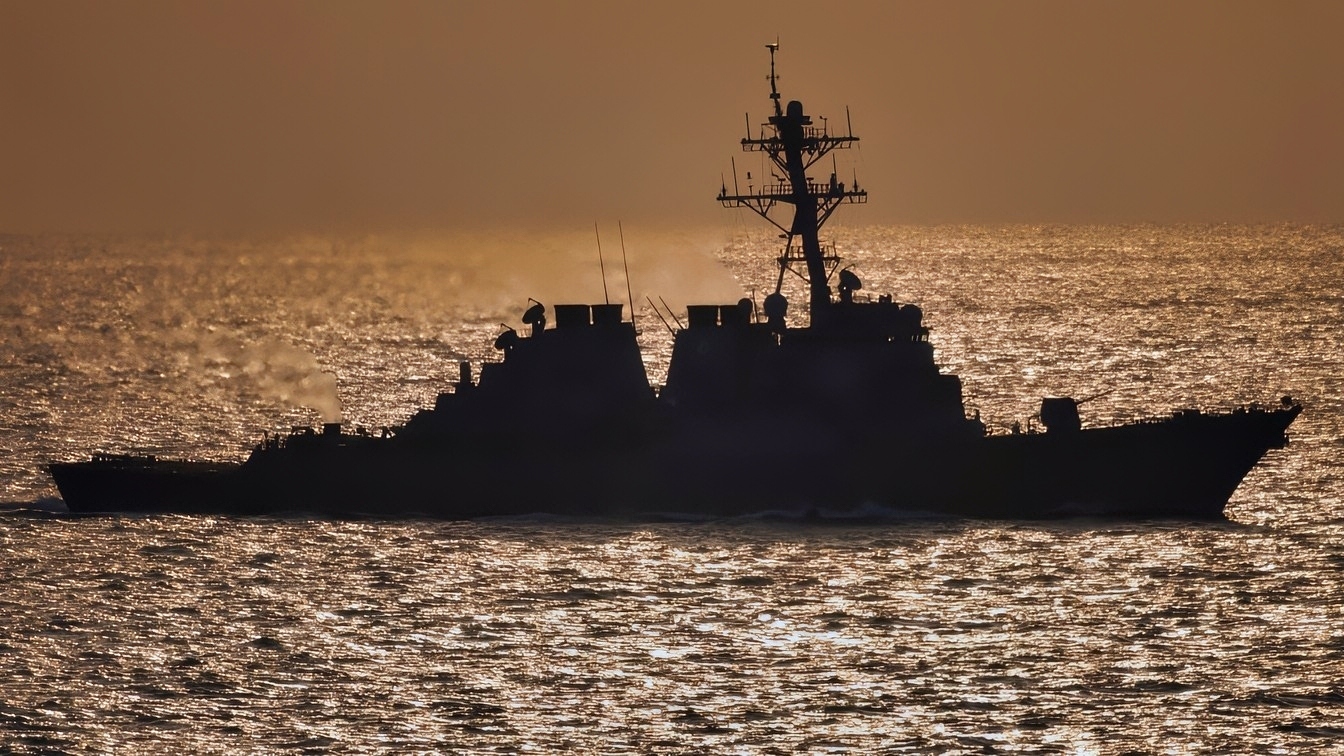
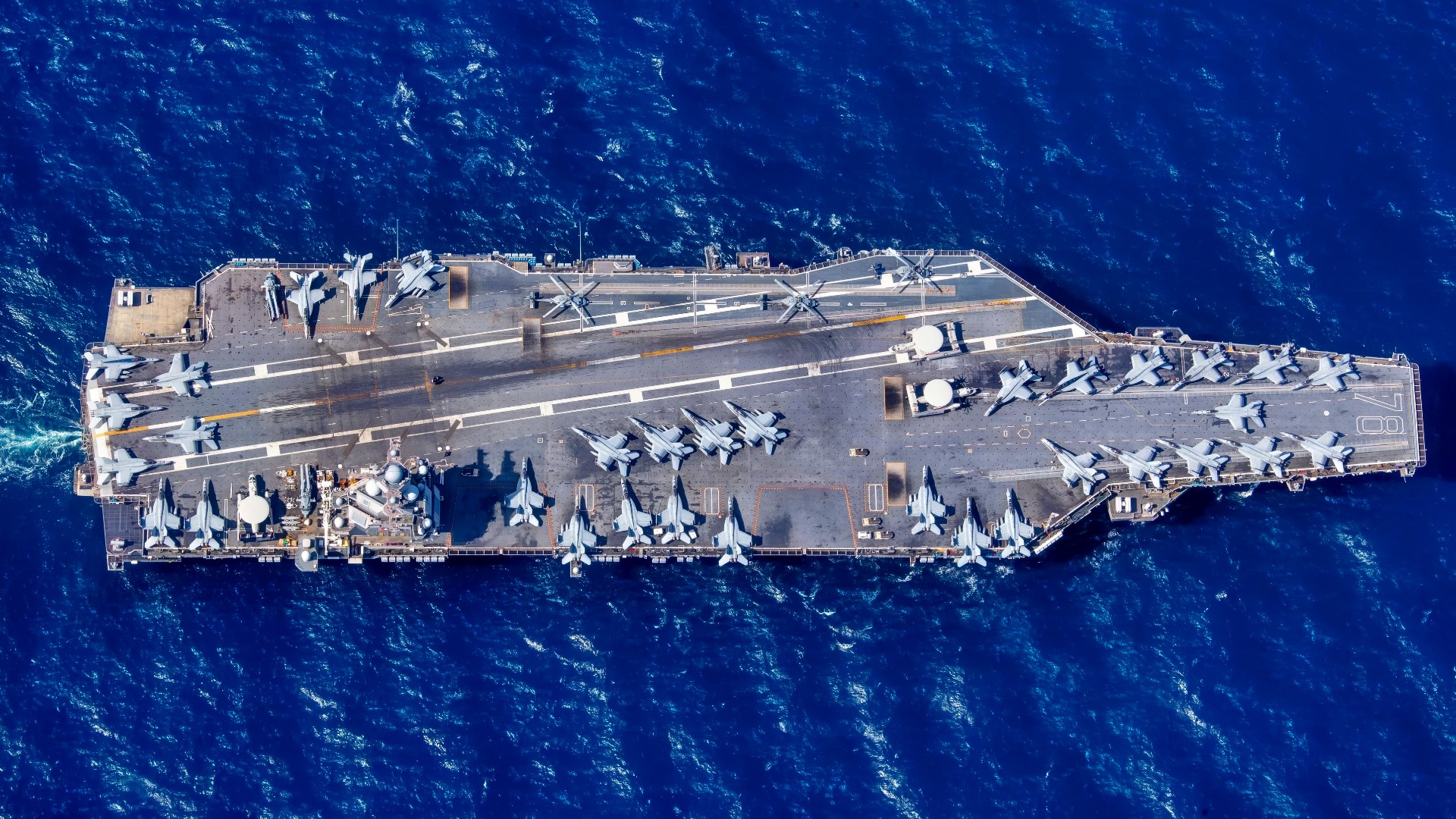
The guided-missile destroyer USS Donald Cook (DDG 75) steams behind the aircraft carrier USS Theodore Roosevelt (CVN 71) in the Persian Gulf on Jan. 31, 2006. The Roosevelt Carrier Strike Group is conducting maritime security operations in the Persian Gulf.
(DoD photo by Airman Apprentice Nathan Laird, U.S. Navy. (Released))
While support is still high among Republicans, Democrats, and independent voters largely disapprove of the war, with most voters still confused as to why the U.S. is attacking Iran in the first place.
As the conflict continues, the U.S. Army faces its prominent threat: public opinion.
This is especially important as the midterm elections approach, providing even more pressure on Trump to finish the war as soon as possible.
Only One in Three Americans Support the War Against Iran
The poll was conducted from Friday, July 24, to Sunday, July 26, garnering responses from 1,248 adults across the United States.
Of those adults, only 33% approved of the war in Iran.
Support among Republicans was naturally higher, with 71% expressing their support for Trump and his war effort. Meanwhile, Democrat participants were almost unanimously against the war, with 93% expressing their disapproval and only 5% in support.
Among independent voters, only a quarter showed support, while 67% disapproved of Trump’s handling of the war in Iran.
One of the reasons why support for the war has been so shaky is that the Trump administration, according to some, has done a poor job explaining why the U.S. is currently fighting a war with Iran. “It’s not clear why we started a war with them. I have no idea,” said Alex Womack, a retired turbine repair specialist from Stockbridge, Georgia.
The war has suffered from mission creep, which has caused the goals of the war to shift as the conflict has gone on. At the start, the goal was to dismantle Iran’s ballistic missile program, and then it was to prevent Iran from obtaining a nuclear weapon.
Now, it is to reopen the Strait of Hormuz—which was closed because of the war. These evolving priorities are confusing to many Americans, who still do not understand why the U.S. and Iran are enemies to begin with.
War Fatigue
Many Americans are simply tired of war, especially in the Middle East. Since 2001, the U.S. has maintained a constant military presence in the Middle East.
Except for the invasion of Afghanistan, which lasted from 2001 to 2021, it initially had an approval rate of 90%.
Meanwhile, the war in Iraq from 2003 to 2011 had an initial approval rating of 70%. Granted, public opinion on both wars eventually soured, but it took years before average Americans became fatigued with the wars.
While there are many differences between the current war with Iran and the past wars in the Middle East, the previous wars had clear goals: dismantle al-Qaeda and overthrow Saddam Hussein.
However, both wars overstayed their welcome and turned into “forever wars.” After these experiences, the notion of entering yet another war was never going to be popular among Americans who remember the humiliating withdrawal from Afghanistan.
There is an extra layer of irony, which has not been lost on many Americans, considering that Trump campaigned on a promise to end foreign wars and keep the U.S. out of more foreign conflicts.
During his 2024 campaign, he declared that he would stop the conflicts between Israel and Hezbollah. Instead, the U.S. has gotten into a confrontation with Venezuela, which saw the abduction of Nicholas Maduro, and now it is engaged in yet another war in the Middle East.
Support for the war has improved slightly since March. During the first week of the war, during Operation Epic Fury, support for the war sat at only 27%. It has since then increased to 33%.
To be completely fair, the U.S. was dragged into the war somewhat involuntarily by Israel, but that still represents a failure by Trump to keep the U.S. out of a regional conflict.
The Rising Political Cost of the War
The economic impacts from the closure of the Strait of Hormuz have also soured many Americans’ opinions against the war.
While the mainland has never suffered a direct attack from Iran, and likely never will, causing gas prices to go up is a surefire way to get the public riled up.
As of now, average gas prices around the country remain at around $4 per gallon, which is a full dollar higher than it was prior to the war.
High gas prices, combined with the ambiguous nature of the war, fatigue from past conflicts, and Trump’s campaign promises to avoid war, have put a lot of pressure on the President and the Republican Party, which is currently preparing for midterm elections later this year.
The U.S. Armed Forces remain the best military on the planet.
The war with Iran has, in many ways, demonstrated the biggest strengths and weaknesses of the U.S. as a military and political force.
While the military has the firepower to wage war against Iran, it is ultimately beholden to a system that is reliant on public opinion (this should not be taken as a criticism; this system is necessary to keep the U.S. out of pointless wars).
War is a politically costly endeavor, and after 20 years of wars in the Middle East, the public wants nothing to do with the war in Iran.
Trump, willingly or not, has now found himself at the helm of an unpopular war.
If he does not end it soon, there will be consequences for the Republican Party.
About the Author: Isaac Seitz
Isaac Seitz, a Defense Columnist, graduated from Patrick Henry College’s Strategic Intelligence and National Security program. He has also studied Russian at Middlebury Language Schools and has worked as an intelligence Analyst in the private sector.