The United Arab Emirates has suspended all trade and financial transactions with Iran, severing one of Tehran’s most critical remaining economic links.
The announcement comes after Iran was accused of launching two ballistic missiles toward maritime traffic near Emirati territorial waters.
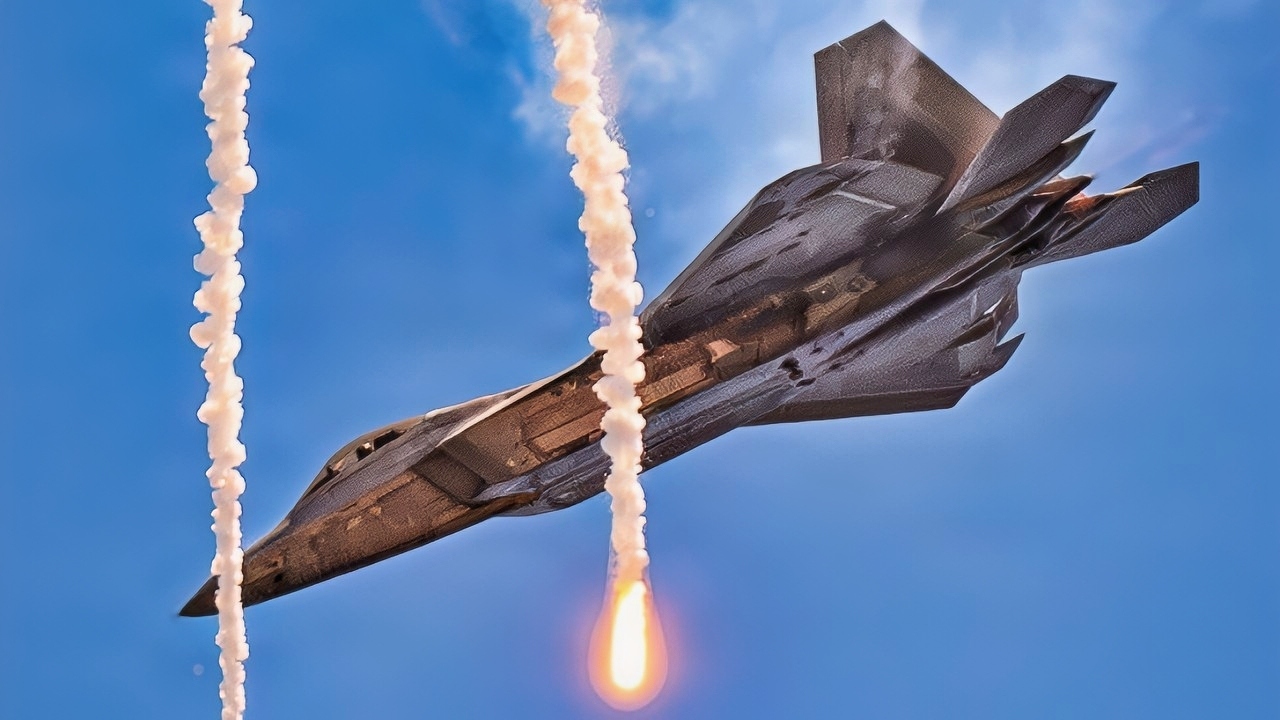
U.S. Air Force Capt. Nick “Laz” Le Tourneau, pilot and commander of the F-22 Raptor Aerial Demonstration Team, performs an aerial demonstration at Air Dot Show Tour Fort Lauderdale, Florida, May 9, 2026. Capt. Le Tourneau showcased the unmatched capabilities of the F-22 by performing a series of combat maneuvers. (U.S. Air Force photo by Staff Sgt. Mary Bowers)
The decision was announced on Wednesday, August 19, and represents a major escalation by Abu Dhabi after months of UAE leadership attempting to preserve its economic ties with Iran even as it was being drawn directly into the nearly six-month-old conflict.
Iran denied launching the missiles and has accused the UAE of making a baseless allegation and working with Washington to apply pressure on the Islamic regime.
The consequences of that missile launch are massive.
The UAE has historically served as Iran’s second-largest trading partner after China and, critically, as a financial and commercial gateway to the wider global economy.
Under heavy sanctions, Iran now finds itself even more isolated than it was before.
Notably, the announcement also comes only days after U.S. Treasury Secretary Scott Bessent promised an unprecedented campaign to economically isolate Iran – suggesting that the decision from the UAE is the first indication of the strategy coming into effect.
Washington is about to economically strangle Iran, but nobody knows how long it will take, or how Iran will respond in the meantime.
What UAE Officials Claim
The UAE government reported on Wednesday that two ballistic missiles had been launched from Iranian territory toward maritime traffic near Emirati waters.
In an official statement carried by the state-run Emirates News Agency, WAM, the UAE Ministry of Defense said its air defense systems had tracked the two missiles after they were launched from Iran.
According to the ministry, both missiles ultimately fell into the Persian Gulf without causing any casualties or damage, with one missile landing inside UAE territorial waters and the other landing outside them.
Emirati authorities also issued emergency alerts to residents during the incident.
The UAE government later cited that incident when it announced the suspension of trade with Iran.
In a separate statement, the government also said that it would cease all trade, commercial exchanges, and financial transactions with Iran, describing the decision as a response to regional developments that “undermine regional and international peace and security.”
Iran Rejects Claims
Tehran, however, has directly rejected the Emirati claims, with Foreign Ministry spokesman Esmail Baghaei claiming that Iran had not launched missiles toward the UAE.
But Iran has previously targeted Emirati-linked commercial shipping during the war, including vessels owned by the state-owned Abu Dhabi National Oil Company (ADNOC) as they attempted to navigate through the Strait of Hormuz.
This Will Hurt Iran
Iran was playing with fire by launching missiles and drones at ADNOC vessels – and if it was indeed responsible for the missile attacks, it could easily be described as an act of self-sabotage.
The UAE has long been Iran’s second-largest trading partner, with bilateral trade totaling roughly $24 billion in 2023-2024.
Perhaps more importantly, Dubai has also served as a re-export and financial hub through which Iranian companies can obtain foreign goods and conduct transactions despite U.S. sanctions.
That relationship would explain why Abu Dhabi has so far been reluctant to sever ties completely.
The UAE began re-engaging with Tehran in 2019 and has maintained extensive commercial relations, even as it has maintained a close security relationship with the United States and disputed Iranian control over three islands in the Gulf.
But those calculations were delicate, and the war with Iran has fundamentally changed them.
Even after announcing the embargo this week, Abu Dhabi has stressed that it remains committed to dialogue with Iran and maintaining regional stability, suggesting the decision is part of an economic pressure campaign intended to secure peace in the region, rather than a total abandonment of diplomacy.
To Tehran, however, it may read as the latter.
Is This Part of Bessent’s Threat?
The timing also suggests that the decision is actually part of the pressure campaign that U.S. Treasury Secretary Scott Bessent announced last week.
On August 13, Bessent said that Washington was preparing economic measures against Iran unlike anything previously attempted and promised further announcements this week.
“And watch this space for more announcements coming next week because we are going to apply measures like have never been seen in the history of the economic isolation of a country,” Bessent told Newsmax.
“It will be a combination of economic isolation like the world has never seen before and the continued blockade in the Strait of Hormuz that will keep anything from going in or out of the Iranian ports,” he continued.
The effect of the UAE announcement is precisely what Bessent described. With U.S. sanctions restricting Iran’s access to international finance and a naval blockade constraining its maritime trade, Tehran has now lost one of its last remaining regional economic gateways and is about to suffer intense economic problems.
About the Author: Jack Buckby
Jack Buckby is a British researcher and analyst specializing in defense and national security, based in New York. His work focuses on military capability, procurement, and strategic competition, and he produces and edits analysis for policy and defense audiences. He brings extensive editorial experience, with a career output spanning over 1,000 articles at 19FortyFive and National Security Journal, and has previously authored books and papers on extremism and deradicalization.