Iran’s oil exports have been on a downward spiral since fresh fighting in and around the Strait of Hormuz has pushed global crude prices up again.
Brent surged to $101.32 on Wednesday, while West Texas Intermediate reached $96.48 a barrel.
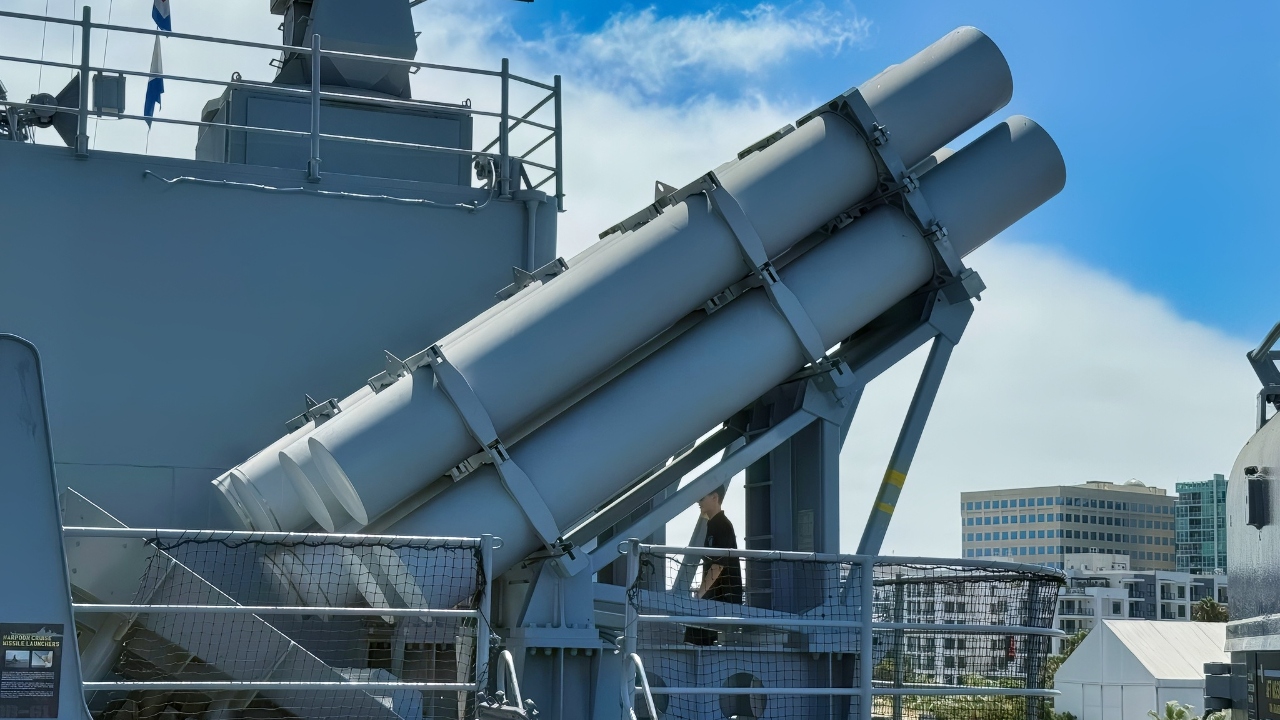
USS Iowa Harpoon Canister. Image Credit: Harry J. Kazianis/National Security Journal.
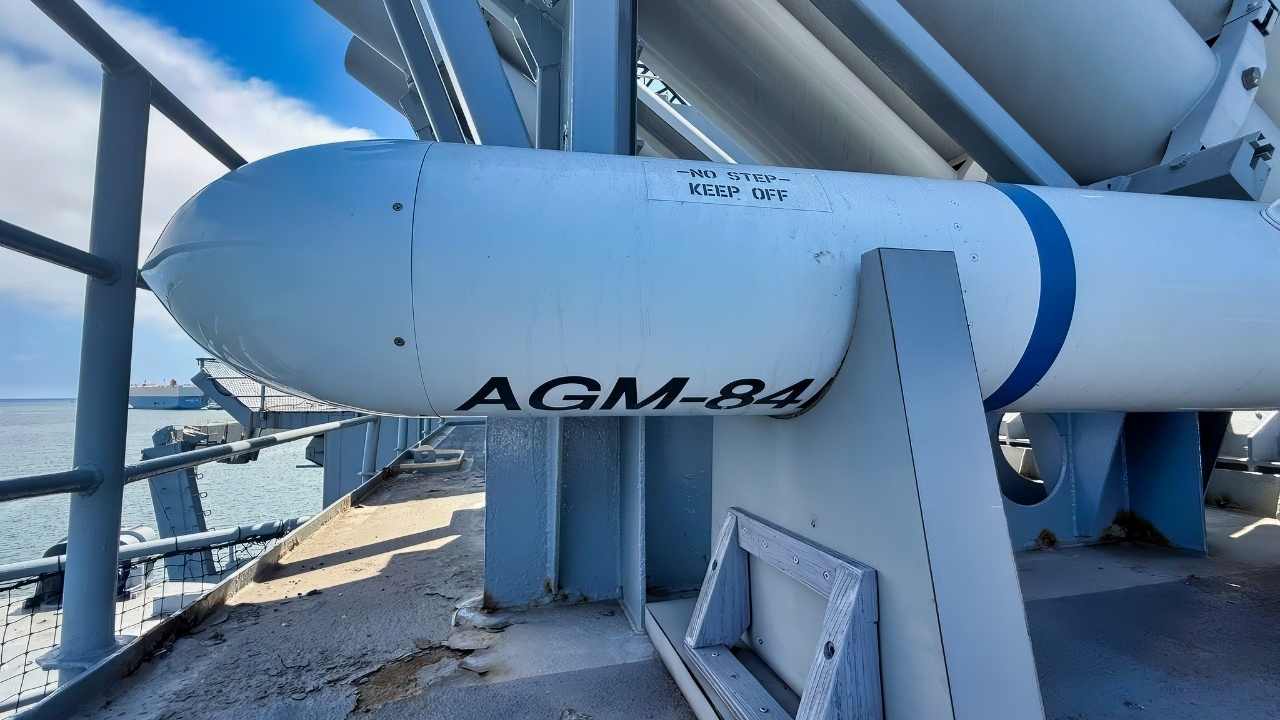
Harpoon Missile Onboard USS Iowa. Image Credit: National Security Journal.
In recent days, the U.S. has carried out strikes on five Iranian oil tankers, while Iran has also launched attacks close to the Strait of Hormuz along with a missile barrage on a U.S. base in Jordan.
U.S. Blockade Hitting Tehran Hard
The Wall Street Journal has cited Kpler data showing that no newly loaded Iranian crude tankers had managed to transit past the strict U.S. blockade reinstated on July 14.
Last month, Iran loaded some 255,000 barrels in the Gulf. This marks a whopping 85% dip from the previous averages in the February-to-April period.
For now, Tehran is still generating revenue from oil sold to China, but much of that revenue was earned before the blockade was reinstated.
Kpler says that Iranian crude already aboard vessels outside the blockade has plummeted from about 90 million barrels in mid-July to roughly 29 million.
At the current delivery rate of approximately 1 million barrels per day, mainly to China, that stock could be exhausted by mid-October.
Just 10 percent of China’s oil imports are Iranian, although China now buys 90% of Iran’s oil exports.
Paknejad: Oil Still Being Sold ‘1000s of Miles Away’
Iranian officials continue to claim that sales are ongoing. Mohsen Paknejad, Iran’s oil minister, said last week that oil was being sold and delivered “thousands of kilometers away from the Persian Gulf.”
However, the claim does not contradict the shipping data as those cargoes were largely moved out during the previous pause in the blockade.
Production is also being affected, with Homayoun Falakshahi, Kpler’s head of crude-oil analysis, telling the WSJ that Iran has seemingly cut output to better align with domestic demand.
Overland alternatives are not an adequate back-up route.
Iran can move only about 40,000 barrels per day by truck, according to Falakshahi, compared with prewar crude exports of nearly 2 million barrels per day.
The rest of the Gulf has adapted more successfully.
Reuters reported Wednesday that industry estimates put Gulf oil exports at 15 million to 16 million barrels per day, roughly two-thirds of prewar volumes.
Such figures obviously fail to account for ships traveling with their Automatic Identification System (AIS) transponders turned off during so-called “dark crossings,” which are harder for hostile actors to detect.
This makes things rather awkward for the Iranian regime.
Its pressure on the Strait of Hormuz disrupts traffic, but it fails to stop rivals such as Saudi Arabia, Iraq, Kuwait, Qatar, and the UAE from moving huge volumes through other routes and strategies. Meanwhile, its own exports are down considerably.
U.S. Destroys 4 Iranian Tankers
The U.S. military claimed to have destroyed four Iranian tankers in the Gulf of Oman and another near Kharg Island after Tehran tried to strike U.S. warships.
Iran responded by firing 20 ballistic missiles toward a base used by U.S. forces in Jordan. Jordan said it intercepted 18.
The Islamic Revolutionary Guard Corps also claimed attacks on two U.S. vessels and eight oil tankers. Secretary of State Marco Rubio put Washington’s response plainly: “for every time they do that or try to do that, they’re going to lose tankers.”
73 people were reportedly wounded in a Houthi attack on Saudi cities and energy infrastructure, the largest barrage launched by the Iran-aligned terror proxy since the start of the U.S.-Iran war in February.
Flows through the Strait of Hormuz also continue to fall.
Claudio Galimberti, a chief economist at Rystad Energy, told Reuters that volumes had fallen to as low as 2 million barrels per day.
They had previously risen to 8-9 million at the end of August, before fighting broke out again.
‘One-Two’ Punch
Despite the financial toll the blockade is taking on Iran, its oil fields may not be damaged in the long term.
As the Journal of Petroleum Technology wrote during the pandemic in 2020, “For the prolific conventional fields in the Middle East, there is very little technical concern about shut-ins and startups.”
Treasury Secretary Scott Bessent called the blockade and sanctions a “one-two punch,” telling CNBC: “It is going to work in Iran, and we are going to collapse this regime.” Former U.S. negotiator Dennis Ross was more cautious, claiming that “The Iranians have consistently surprised us in terms of their resiliency.”
About the Author: Georgia Gilholy
Georgia Gilholy is a journalist based in the United Kingdom who has been published in Newsweek, The Times of Israel, and the Spectator. Gilholy writes about international politics, culture, and education.