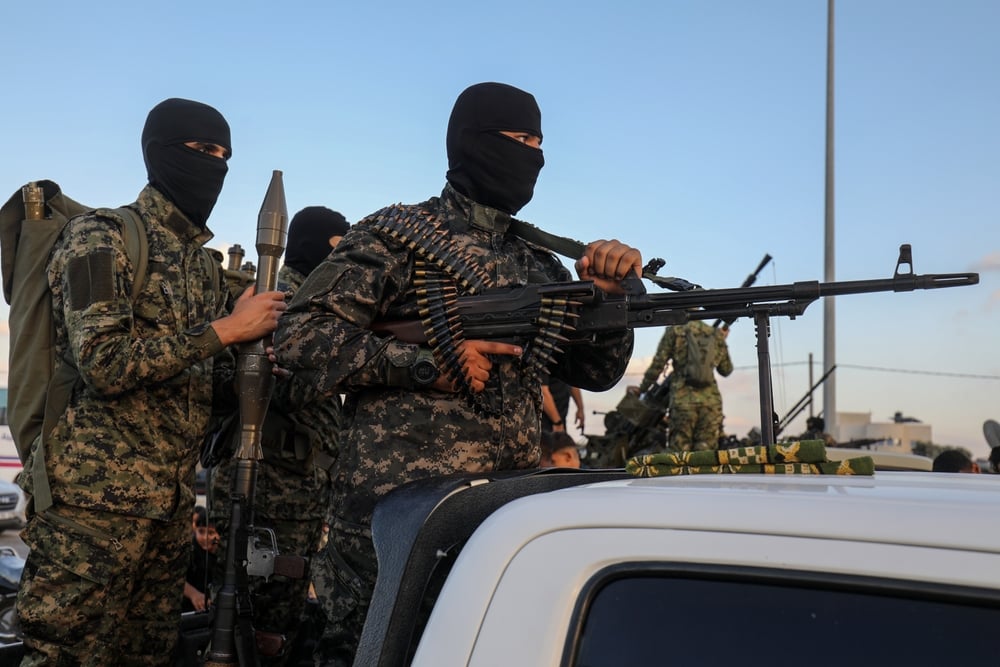
“Things are very difficult. Since the morning, they’ve been arresting people and kidnapping people from the streets. Things are very bad.”
By Debbie Weiss, The Algemeiner
Armed Hamas operatives arrested Gazans in the streets and rounded up others at hospitals on Friday as the Palestinian terrorist group moved to suppress planned protests calling for an end to its rule, a resident of central Gaza told The Algemeiner.
The demonstrations, billed on flyers as the “June 26 Peaceful Revolution,” were planned for dozens of locations across the Gaza Strip, including Nasser Hospital in Khan Younis and Al-Shifa Hospital in Gaza City.
One month ago, seeking to capitalize on the growing discontent, a Gazan dissident group issued a public call for an anti-Hamas “revolution of rage” to be held on June 26.
Although hesitant to mention Hamas by name, the organizers denounced “the arrogance” of “a government that has separated itself from its people, usurped their right to participate or even ask questions, and monopolizes all national decision-making.”
Organizers called for protests against Hamas rule and, according to flyers circulated ahead of the demonstrations, accused officials of exploiting Gaza’s medical evacuation system at hospitals by selling places on travel lists to people desperate to leave the enclave for treatment at a hefty premium, rather than granting exits based on medical need.
The anti-Hamas protests erupted in Gaza City and Khan Yunis pic.twitter.com/b3Z2DfEpFP
— Visegrád 24 (@visegrad24) June 26, 2026
But by Friday, Hamas appeared to have largely succeeded in choking off the protests before they could gather momentum, according to a resident of the Rimal neighborhood in Gaza City. Many of the planned protest sites were empty, he said, after a campaign of arrests, threats, and intimidation.
The man, who asked that his name be withheld for his safety, said people had been detained or rounded up at four hospitals in Gaza, including Al-Shifa Hospital, Nasser Hospital, Al-Ahli Arab Hospital, and Al-Aqsa Martyrs Hospital.
“The situation in Gaza is very difficult. They are kidnapping people and threatening people. The level of terror is high,” he told The Algemeiner earlier on Friday.
“There are fatwas calling for killing and fatwas declaring people infidels in the mosques, and calls saying the protest movement has been postponed,” he said. “Things are very difficult. Since the morning, they’ve been arresting people and kidnapping people from the streets. Things are very bad.”
HORRIFIC: Hamas militias are deploying their armed, masked men into the streets across the Gaza Strip to crush the protests. pic.twitter.com/PbtAmnJ1jO
— Ihab Hassan (@IhabHassane) June 26, 2026
One of the warnings came from the Association of Palestinian Scholars, an influential Palestinian religious body, which described the protest campaign as “a criminal movement,” according to a report in the UK’s Telegraph news outlet.
The group accused those behind it of helping “the occupier,” meaning Israel, and of trying to achieve political goals Israel had failed to secure through military force. It also warned that anyone tied to the demonstrations could be accused of collaboration with Israel, an offense punishable by death under Hamas rule.
Hamas’s fear, according to activists cited in the report, was not only that the protests could spread, but also that rival armed groups could use them to expand their control in parts of Gaza, or that Israel could use the unrest to target Hamas operatives.
Protest organizers said they were trying to avoid precisely that scenario, arguing that any involvement by Israel or armed militias would give Hamas a pretext to crush the demonstrations.
By Friday afternoon, media outlets affiliated with Hamas were publishing footage of empty intersections where protests had been planned, declaring the “Failure of the June 26 Revolution.”
Hamas terrorists & militiamen are making meme posts showing different parts of Gaza being completely dead/no people present. Yes, Gaza, with tens of thousands to every square kilometer, is eerily empty, highlighting the severity of Hamas’s terror campaign against Gazan protesters pic.twitter.com/9NTQW6yuM8
— Ahmed Fouad Alkhatib (@afalkhatib) June 26, 2026
Ahmed Fouad Alkhatib, a humanitarian activist originally from Gaza who now lives in the US, wrote on Thursday that Hamas had launched an “industrial-scale campaign of terror, intimidation, interrogation, and blackmail against thousands of Gazans” who had planned to join the protests.
His account echoed the testimony of the Rimal resident, who said hospitals had become a central point in the crackdown. Alkhatib wrote that hospitals across Gaza had been turned into “makeshift police stations, interrogation sites, and torture centers.”
“Families are being threatened, people placed under house arrest, and Hamas’s al-Qassam brigades (the same forces responsible for October 7) have been fully mobilized to reinforce police and intelligence units with explicit shoot-to-kill order,” he wrote on social media, referring to the Hamas-led invasion of and massacre across southern Israel on Oct. 7, 2023.
Ahed al-Hendi, a senior fellow at the Center for Peace Communications, assessed that the June 26 organizers did not anticipate the ferocity of Hamas’s response.
“The fact that organizers announced the protest weeks in advance made it easier for Hamas to prepare, intimidate people, pressure families, and silence the movement before it reached the streets,” he said. “In Gaza, protest movements have often been more successful when they were organized quietly and appeared suddenly. This time, the early announcement gave Hamas the time and pretext to suppress it.”
Alkhatib accused international media outlets and pro-Palestinian activists of ignoring the crackdown because it could not be blamed on Israel.
He condemned the “mainstream media” for failing to report on the campaign, saying it was “apparently because Israel is not involved – so no Jews, no news.”
Alkhatib also said much of the Western pro-Palestinian movement had either ignored the protests or cast those taking part as collaborators undermining Hamas’s “resistance,” while the UN, NGOs, and major human rights groups had remained silent as Gazans risked their lives to oppose Hamas rule.
To all Western media, including pro-Palestine outlets: right now, thousands of Palestinian civilians are taking part in massive anti-Hamas protests across the Gaza Strip.
Stand with them. Carry their voices. Don’t abandon them. pic.twitter.com/kPra1N5MAa
— Ihab Hassan (@IhabHassane) June 26, 2026
“This is what the abandonment of Palestinians in Gaza looks like. Shame on all who stay silent in the face of jihadi, ISIS-like violence against the very people they claim to champion.”
Alkhatib added that friends of his had been detained at Al-Ahli Arab Hospital.
Al-Ahli Arab Hospital became one of the most disputed flashpoints of the early war after Gaza officials claimed in October 2023 that an Israeli strike had hit the hospital and killed about 500 people, a claim that was quickly amplified by major international outlets, including The New York Times. Israel denied responsibility and said the blast was caused by a misfired Palestinian Islamic Jihad rocket, an account later backed by US intelligence. The Times later acknowledged that its early coverage had relied too heavily on Hamas’s claims and left readers with an incorrect impression about what was known.
On Friday, Alkhatib said Hamas had also sent “fake journalists” to protest sites under the guise of covering the demonstrations but actually to identify and arrest anyone who showed up.
Gaza’s few independent journalists have been feeling the heat as well.
“For the past several days, our reporters and several of Gaza’s most prominent anti-Hamas activists have been subjected to an intense campaign of surveillance and intimidation by Hamas,” Hadeel Oueiss, editor-in-chief of Jusoor News, told The Algemeiner.
“And we’re hearing about many activists who have been effectively placed under house arrest by Hamas,” he added. “They’ve made it clear their number one goal is to prevent any anti-Hamas demonstrations from taking place in Gaza.”
The post Hamas Terrorizes Gazans to Crush Planned Protests appeared first on World Israel News.