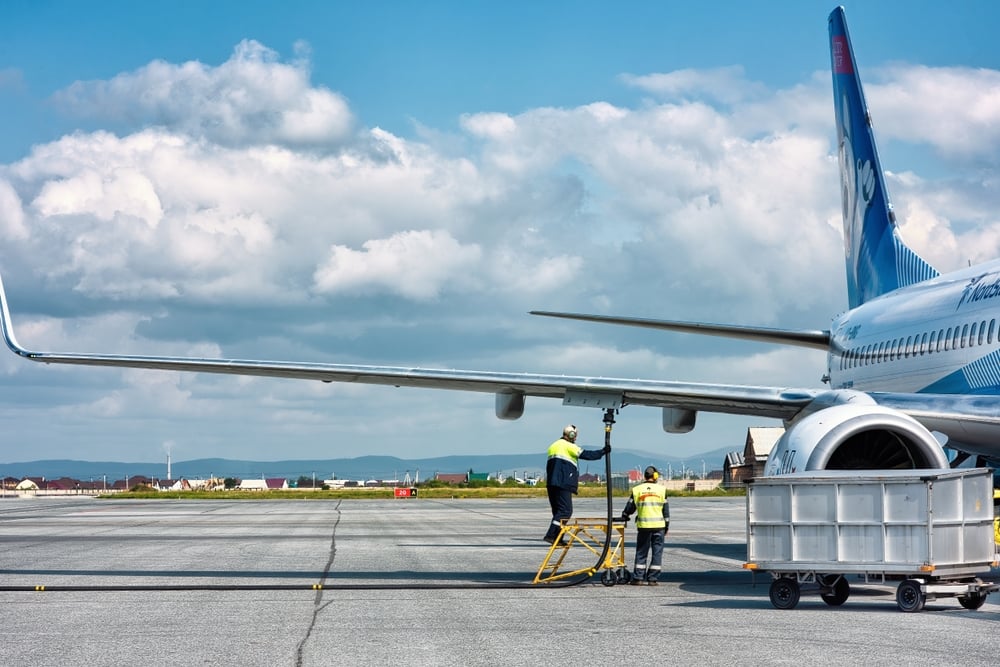
While crude oil prices have risen by about 35 percent due to disruptions in the Strait of Hormuz, jet fuel prices have surged by as much as 95 percent.
By Dalga Khatinoglu, Middle East Forum
Since the United States and Israel launched their campaign against the Islamic Republic, Iran has delivered a severe shock to global aviation, particularly in the Middle East. Normal conditions will not soon return.
The current crisis goes beyond flight cancellations or air transport costs.
By disrupting the Strait of Hormuz—one of the main transit routes for jet fuel—and targeting refineries in Arab countries, Iran has created conditions in which airlines and passengers will face fuel shortages and elevated prices for at least three months.
On April 8, 2026, the International Air Transport Association warned that both supply and prices of jet fuel may take months to normalize.
Meanwhile, the Airports Council International Europe cautioned that without the full reopening of the Strait of Hormuz, European airports could face a “systematic” shortage of jet fuel, noting that current reserves at European airports will last only about three weeks.
On April 9, 2026, the International Monetary Fund reported that the number of daily flights in the region has been cut in half, while global jet fuel prices have doubled.
The United Nations Economic and Social Commission for Western Asia stated that in just the first two weeks of the conflict, nine major regional airlines canceled nearly 19,000 flights, resulting in losses of approximately $1.9 billion.
Given the continued disruptions, total losses for regional airlines are now estimated to have reached at least $3 billion.
Major regional carriers—particularly Qatar Airways and Emirates—are now under unprecedented pressure.
Together, these two airlines hold around $45 billion in assets and recorded more than $8 billion in net profit last year, accounting for roughly one-fifth of the global aviation industry’s total profit.
However, the continuance of tensions could erode this competitive advantage.
Before the launch of U.S. and Israeli military operations, Iran’s registered aviation fleet stood at around 330 aircraft. However, there were significant discrepancies regarding the number of operational planes.
Some industry officials estimated the active fleet at around seventy-five aircraft, while others put the figure as high as 156.
Even in the most optimistic scenario, only 30 percent of the fleet was operational, with the majority grounded due to spare parts shortages, high maintenance costs, aging, and sanctions-related constraints.
According to Iran’s Civil Aviation Organization, the average age of the country’s operational fleet also is between twenty-six and twenty-seven years—a figure that clearly highlights the gap between Iran’s aviation sector and global standards.
During thirty-nine days of military operations, the United States and Israel targeted dozens of Iranian aircraft and airports. The current state of Iran’s aviation sector remains unclear.
Since the outbreak of the conflict, global jet fuel prices have doubled, placing additional pressure on airlines worldwide.
While crude oil prices have risen by about 35 percent due to disruptions in the Strait of Hormuz, jet fuel prices have surged by as much as 95 percent.
The reason lies in the composition of flows through the Strait: Roughly one-quarter consists of refined petroleum products, particularly diesel and jet fuel.
In recent weeks, industrialized countries have partially stabilized global oil markets by releasing strategic reserves.
However, jet fuel markets—especially in Europe, which depends on Middle Eastern refineries—have faced shortages.
Before the disruption of the Strait of Hormuz, the United Arab Emirates, Kuwait, and Saudi Arabia together exported about 3.3 million barrels per day of refined petroleum products through the waterway, including around 500,000 barrels per day of jet fuel.
Compounding the crisis, Iran’s repeated attacks on refineries in Gulf Arab states have inflicted significant damage on critical infrastructure.
Iran has repeatedly targeted Kuwait’s major Mina Al-Ahmadi and Mina Abdullah refineries, with attacks continuing even after the ceasefire.
On April 10, the French energy company TotalEnergies reported damage to Saudi Arabia’s advanced Saudi Aramco Total Refining And Petrochemical (SATORP) refinery during Iranian strikes in the days following the ceasefire.
One refining unit was damaged, and operations at other units and security forced the temporary halted of other units.
TotalEnergies is the shareholder of this major refinery, which has a daily processing capacity of 465,000 barrels of crude oil, with jet fuel being one of its key products.
In addition to these factors, rising security risks and insurance costs have strained global airlines. Insurance premiums for flights in high-risk areas have increased significantly, and some routes have effectively lost insurance coverage altogether.
This has forced airlines to reroute flights—often resulting in longer travel times, higher fuel consumption, and reduced fleet efficiency.
The consequences of this crisis are not confined to the Middle East. Data from Flightradar24 show that since the start of the Iran conflict and the surge in jet fuel prices, flight volumes in Europe and Asia have declined by more than 8 and 22 percent, respectively—highlighting the spillover effects on the global air transport network.
The post The Iran war’s damage to global aviation appeared first on World Israel News.