MY WORKING theory is that the author behind the book of Judges and the long snubbed book of Jasher are one and the same. The exact number of scribes is unimportant to this hypothesis. I believe the similarities between both narratives should be studied. Both writers deal in sensationalism. They equally favor strange and supernatural occurrences rather than the ordinary routine, whereas Moses often seems to downplay the same events. Neither details the specifics of the Law of Yahuah, but moral depravity becomes the norm, and in both accounts, their protagonists propel the narrative forward by muscling through the gray areas of human cognition. Problems often seem resolved with vice. Think Sampson. Actually, the author asserts that people continually do what is right in their own eyes.
I wanted to lay that thought out there and then move on to my second working theory, and it’s this. Jasher is not dependent upon Torah for its telling. Rather, Jasher and Genesis were working from the same parent sources. Nowhere does Jasher comes across as a “fill in the blanks” sort of narrative, as extra-Biblical books tend to have a reputation for. You know, focusing in on the mysteries left unexplained by Torah. Jasher’s author does not necessarily dabble in such imaginative exercises. If anything, it seems at times unaffected by Moses’ own telling, affording great lengths to expound upon history or even gloss over Moses’ interest as its sources inspire. I suggest you read my paper on how Moses sourced his information from as many as 20 different authors when writing Genesis. Toledoth. If not, some of what I have to say may in fact be lost to you. But the short of it is this. Moses stitched his narrative together very much like a multi-generational family quilt. Everyone from Adam to Ishmael, and Shem to Isaac, and most importantly, Yahuah, had a part in the telling.
If you’ve read this far, you may be wondering what any of this has to do with Sodom being destroyed, and not because of homosexuality, per say. The per say is important, because homosexuality is an abomination (Leviticus 18:22; 20:13). But then again, so is eating pork (Deuteronomy 14:3-21; Isaiah 66:17), and I’m willing to bet the citizens of Sodom loved bacon. My entire point is, when we’re comparing Genesis and Jasher’s account of Sodom, only Moses thinks to bring up the homosexuality. If the author of Jasher were simply sourcing Moses and then further expounding upon his own imagination, you wouldn’t think he’d leave that very important detail out.
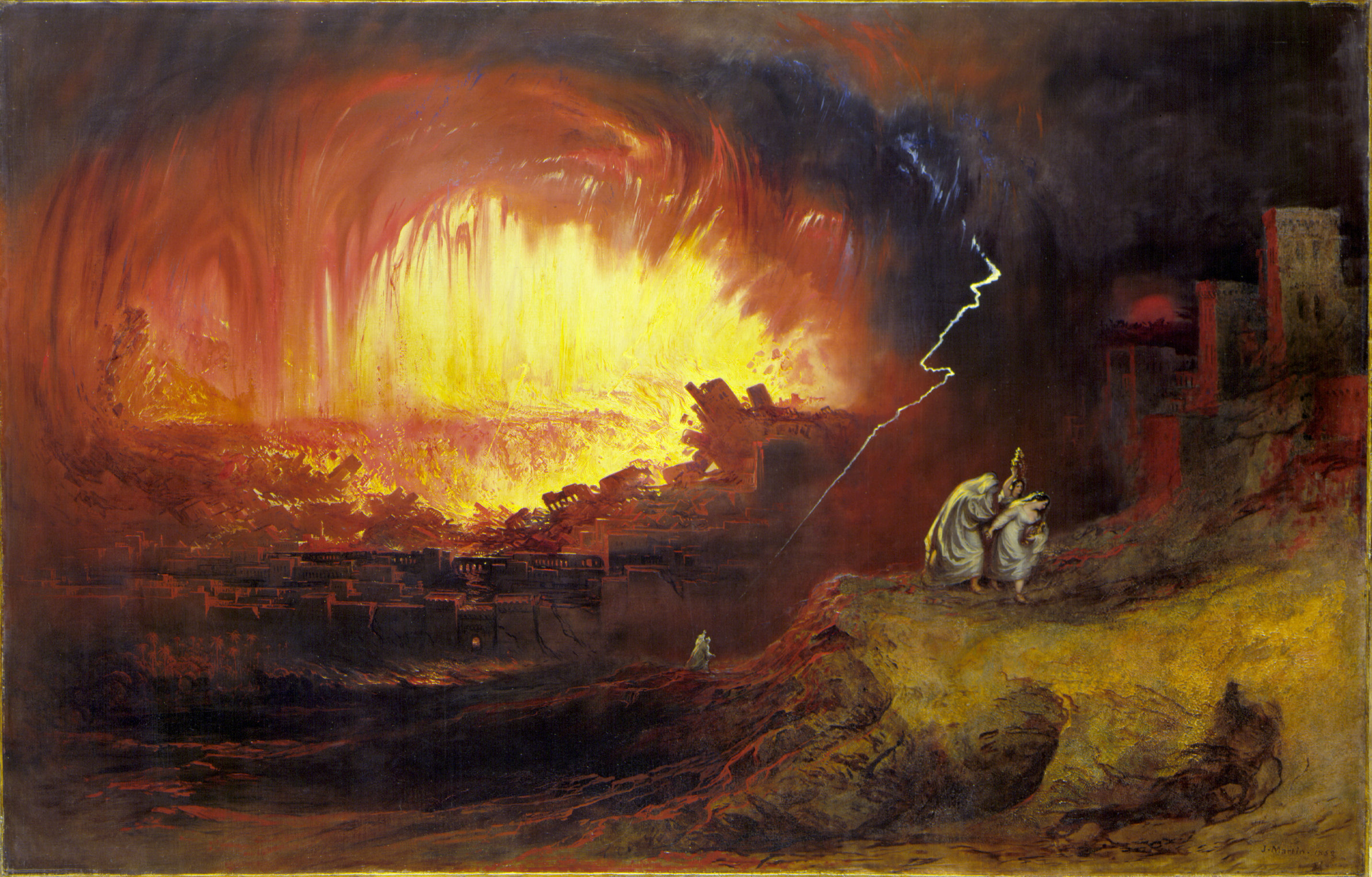
The Sodom and Gomorrah story can be found wedged between chapters 18 and 19 of Genesis. If the next toledoth phrase is not found until Genesis 25:19, and it reads, “And these are the generations of Isaac, Abraham’s son,” then I am inclined to believe that both Moses and the writer of Jasher are pulling their information from Isaac. Abraham wrote nothing. This account alone adds credence to my theory. The writer of Jasher is not looking to Moses and seeking to add it. No, they’re pulling from the same source.
Let’s look to Moses first. Follow along, starting in chapter 19.
We find Lot sitting in the gate of Sodom, probably as evening nears, when the two messengers arrived. Though they are invited as overnight guests into his home, the angels initially decline. Their intent, they tell him, is to abide in the street all night. My Bible reads “the open square.” How odd.
One chapter earlier, in Genesis 18, the two angels met Abraham by the terebinth trees of Mamre, this time accompanied by a third individual identified either as Yahuah or one speaking with His authority, while he was sitting in the door of his tent in the heat of the day. It is there where Yahuah made His plans known. They were on their way to Sodom to personally investigate whether the sins of the city were as bad as the report He’d received. Specifically, an outcry had reached heaven.
What outcry?
Moses doesn’t tell.
The Book of Jasher goes into great detail describing the sins of Sodom. The cities dealings and judgement can be found in chapters 18-20. Essentially, “they strengthened in aging abominably,” undoubtedly one of the reasons why Elohim continued decreasing the longevity of man. This generation succeeded in the sort of moral decline which might otherwise demand a multitude of short-lived generations. For example, Jasher 18:11-15 records that “all the people” of Sodom and Gomorrah participated in these music festivals four times each year, in which husbands would freely sleep with their neighbors wives and virgin daughters, “and each man saw his wife and daughter in the hands of his neighbor and did not say a word.” This is a clear breaking of Yahuah’s Law, and probably in so many places that I don’t even know where to begin. But Leviticus 18:7-16 and 20:11-21 will probably cover it.
Details of sin and vice and political corruption are quite extensive. This is where the angels desire to “abide in the street all night” comes in. The judges of Sodom and Gomorrah, by desire of the people, had beds erected in the streets in order that travelers might sojourn there. While the pilgrim slept, a mob would spring upon him, tie the helpless victim down, and sadistically torture the soul to the point of death. Bodies were dumped in the desert.
Much can be explained by Jasher, important details which Genesis seems to glaze over. For example, on the very day in which the three angels visited Abraham, the patriarch was sitting in the door of his tent “in the pain of his flesh,” having only circumcised his entire household three days earlier. Jasher 18:1-4. That’s a fascinating contrast. Sodom was infamous for stealing, starving, and ultimately murdering those who dared to visit it. Actually, they’d made laws of it. From a nearby hill, Jahser records, Abraham “always prepared in his tent meat and drink to those that passed through the land (Jasher 26:37).” No wonder why Moses has the three angels visiting Abraham on their way to Sodom. In order to obey the Law of Yahuah, Abraham disobeyed the laws of Sodom, and one must begin to wonder if his tent was not placed there, within sight of the city, and on the road in and out, no less, for purposes of kingdom building. Abraham’s heart thought of little else but saving them.
Speaking of which, Abraham received word of his seed inheritance while he and Sarah were tending to his heavenly visitors, and only three days after circumcising his household. On the morning after, the people of Sodom were utterly cut off. The man who would inherit the earth watched the smoke of their torment rise from afar.
The sin which ultimately prompted Yahuah’s investigation derives from a young woman who was judged guilty of “transgressing the law” for fetching a poor traveler bread and water. As consequence, the Sodomites anointed her with honey, head to foot, and placed her before a swarm of bees. The bees stung every smooth area of her naked flesh until her whole body swelled. But none, Jasher records, took pity upon her, as “her cries ascended to heaven.” Jasher 19:42-43.
There it is. The cry which Moses wrote about. A woman and honey.
Jasher skims right over details which Genesis expounds upon. The mob of homosexual zombies, who demand sex with the angels outside of Lot’s home, are mentioned nowhere in Jasher. Likewise, Genesis skims right over details, important details, which can be easily overlooked, even misunderstood, if we don’t have the proper historical context given by Jasher. I’ll let you think about why that might be.
Abraham knew something about Sodom’s vices. One of Sarah’s own servants was beaten bloody there. This lends further credence to Abraham’s own plea that the cities be spared after Yahuah’s investigation. He desired mercy rather than vengeance. Even Paltith, Lot’s own daughter, was thrown into a fire and burned to ashes, on sentence of Sodom’s judge, for secretly nursing a poor traveler back to health (Jasher 19: 25-35). This perhaps helps us understand Lot’s own mindset when, in Genesis 19, he offered another one of his daughters to the men of the city as consequence for transgressing its laws. Lot knew he was disobeying the law in order that he might obey the laws of heaven. He not only steered the angels away from the open beds, but was feeding them as well. Its penalty was death.
Sodom’s sin was disobeying Torah.
Noel
JOIN OUR NEWSLETTER!
Stay up to date on the latest articles and news from Noel.